

Mark, a recruitment company owner, believed that his greatest task would be to acquire additional clients. But he faced challenges handling the money behind them.
The complexity increased along with his recruitment agency. Clients took weeks to pay invoices, contractors had to be paid on schedule, and cash flow grew more unpredictable. Making sure payroll was completed on time felt like a race against the clock every Friday.
Then he realised that the system that supported the development was the issue, not the growth itself. His accounting program was not designed with recruitment firms in mind. Managing the company became much less stressful after he moved to a system that handled timesheets, payroll, invoicing, and cash flow all in one place.
Selecting the appropriate accounting software for recruitment companies can mean the difference between having clear control over your finances and constantly chasing numbers. You can find the ideal option for your organisation with our guide. We will be covering recruitment accounting software and why it’s needed.
Why Recruitment Agencies Need Specialised Accounting Software
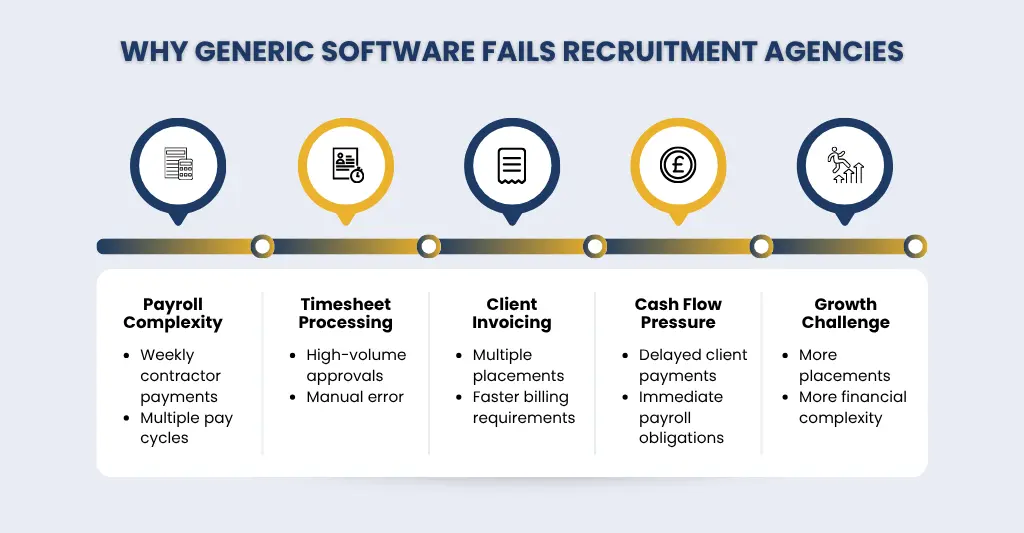
- Manages Complex Payroll Processes: Efficiently manages payroll for contractors, permanent employees, and temporary workers on a weekly, biweekly, and monthly basis.
- Integrates Timesheets with Payroll: Reduces human labour and mistakes by automatically converting authorised timesheets into payroll computations.
- Simplifies High-Volume Invoicing: Even when handling several placements and assignments, it produces customer invoices fast and precisely.
- Improves Cash Flow Visibility: Offers up-to-date information on funding arrangements, payables, and receivables to help make smarter financial decisions.
- Supports Invoice Factoring and Funding: Keeps track of advances, repayments, and factoring capabilities to assist organisations in maintaining a positive cash flow.
- Provides Recruitment-Specific Reporting: Provides thorough reports on customer accounts, placements, consultant performance, and profitability.
- Saves Time for Core Business Activities: Allows recruitment teams to concentrate on hiring, client service, and revenue growth rather than paperwork management.
Segment-Specific Software Recommendations
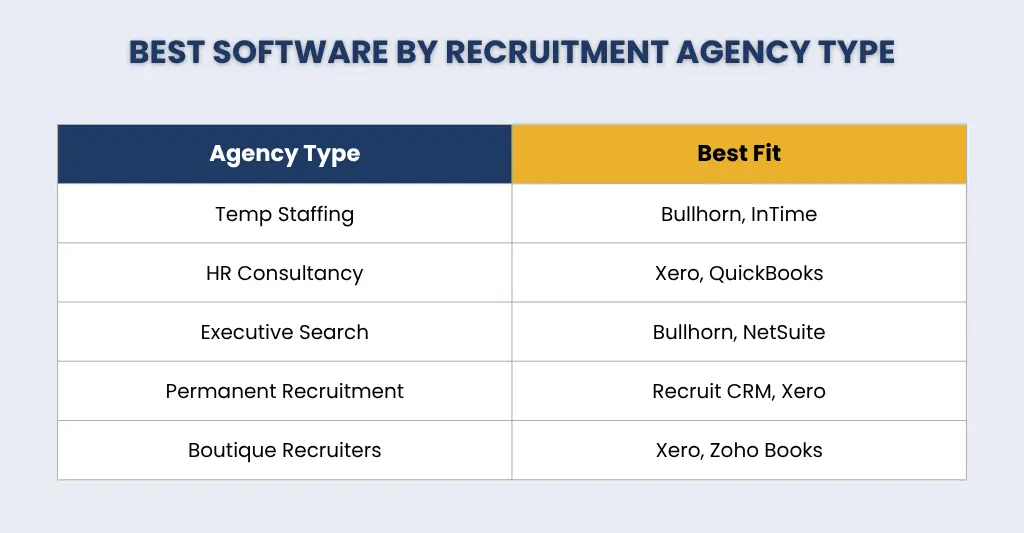
Temp Staffing Agencies:
Temporary staffing companies face various financial hurdles such as managing a large volume of temp employees, paying weekly payrolls, tracking timesheets and creating bills to support completed hours worked. To maintain positive cash flow, they often turn to invoice factoring.
Agencies placing contractors should also stay informed about changing compliance requirements. Our guide to IR35 umbrella legislation changes from April 2026 explains what recruitment agencies and businesses need to prepare for.
Recommended Software:
#1. Bullhorn:
- Pros:
- Specifically built for staffing and recruitment firms
- Integrates payroll, CRM, ATS, and billing functions
- Excellent reporting and analytics capabilities
- Cons:
- Higher implementation and subscription costs
- May be overly complex for smaller agencies
#2. InTime
- Pros:
- Strong workforce scheduling and timesheet management
- Automated payroll and compliance tracking
- User-friendly interface for temporary workforce management
- Cons:
- Limited accounting features compared to dedicated accounting platforms
- Customisation options can be restrictive
#3. Recruit CRM + Xero Integration
- Pros:
- Combines recruitment management with cloud accounting
- Real-time invoicing and financial visibility
- Cost-effective for growing staffing businesses
- Cons:
- Requires integration setup and ongoing management
- Advanced financial reporting may require additional tools
HR Firms:
HR companies usually concentrate on workforce advice services, training, talent management, and consulting. Project-based billing, payroll management, expense monitoring, budgeting, and client invoicing are frequently at the center of their accounting requirements.
Recommended Software:
#1. Xero
- Pros:
- Easy-to-use cloud platform
- Strong project tracking and expense management
- Excellent integration ecosystem
- Cons:
- Payroll functionality may require third-party integrations in some regions
- Advanced reporting can be limited
- Pros:
- Comprehensive financial management tools
- Automated invoicing and bank reconciliation
- Wide accountant and advisor support network
- Cons:
- Pricing increases as businesses scale
- Some advanced features require higher-tier plans
#3. Zoho Books
- Pros:
- Affordable pricing structure
- Strong automation workflows
- Seamless integration with the Zoho ecosystem
- Cons:
- Less suitable for complex multi-entity organisations
- Smaller third-party integration marketplace than competitors
Executive Search & Recruitment Firms:
Finding the ideal applicant for senior-level roles frequently takes several months for executive search firms. They require software that enables them to precisely track client contracts, invoices, and income because payments are typically made in instalments or through retainer fees. The software should also help monitor consultant performance, measure the profitability of each placement, and provide clear financial reports. Businesses can run their operations more effectively and make better business decisions by integrating accounting and recruitment services.
Recommended Software:
#1. Bullhorn
- Pros:
- Industry-leading recruitment and executive search platform
- Robust reporting and performance tracking
- Strong CRM and client relationship management
- Cons:
- Significant investment required
- Longer implementation period
#2. Recruit CRM
- Pros:
- Combines ATS, CRM, and recruitment workflows
- Easy to implement and manage
- Competitive pricing for growing firms
- Cons:
- Financial functionality depends on accounting integrations
- Limited enterprise-level customisation
#3. NetSuite
- Pros:
- Advanced financial management and forecasting
- Excellent revenue recognition capabilities
- Supports multi-entity and global operations
- Cons:
- Expensive compared to SMB-focused solutions
- Requires specialist implementation and training
#4. QuickBooks Online
- Pros:
- Easy invoicing and retainer tracking
- Strong financial reporting
- Cost-effective for smaller executive search firms
- Cons:
- Limited scalability for larger organisations
- Fewer recruitment-specific features
Permanent Recruitment Agencies:
As recruitment firms that provide placements for their permanent clients may be charged through the use of placement fees and consulting commissions, the recruitment firms will require an accounting software which allows for easy tracking of placements and commissions, effective management of client invoicing, and the generation of accurate financial projections.
Recommended Software:
#1. Recruit CRM
- Pros:
- Tracks placements, candidate pipelines, and commissions
- User-friendly interface
- Affordable pricing for recruitment firms
- Cons:
- Requires integration for full accounting functionality
- Limited advanced financial reporting
#2. Bullhorn
- Pros:
- End-to-end recruitment and billing management
- Strong analytics and placement tracking
- Highly scalable platform
- Cons:
- Premium pricing
- Steeper learning curve
#3. Xero
- Pros:
- Excellent invoicing and cash flow management
- Easy bank reconciliation
- Strong integration capabilities
- Cons:
- Limited recruitment-specific functionality
- Advanced budgeting features may require add-ons
#4. QuickBooks Online
- Pros:
- Simplifies commission and revenue tracking
- Comprehensive financial reporting
- Easy integration with recruitment software
- Cons:
- Additional costs for advanced features
- Less automation for recruitment-specific processes
Boutique/Specialist Recruiters:
Small teams and limited administrative resources are common in boutique and speciality recruitment agencies. They require accounting software that is accessible, user-friendly, and scalable as the company expands. Financial reporting, commission management, cost monitoring, invoicing, and CRM integration are often essential requirements.
Recommended Software:
#1. Xero
- Pros:
- Simple, intuitive interface
- Affordable for small businesses
- Excellent cash flow visibility
- Cons:
- Advanced features may require third-party apps
- Limited built-in payroll in certain regions
#2. Zoho Books
- Pros:
- Budget-friendly pricing
- Strong automation capabilities
- Easy setup and maintenance
- Cons:
- Not ideal for complex financial structures
- Limited advanced reporting options
#3. QuickBooks Online
- Pros:
- Upgrade the software as the company grows.
- Comprehensive accounting functionality
- Large support and advisor network
- Cons:
- Can become expensive with multiple users
- Learning curve for advanced features
#4. Recruit CRM
- Pros:
- Specifically designed for recruiters
- Tracks placements, clients, and commissions efficiently
- Integrates with major accounting platforms
- Cons:
- Limited standalone accounting functionality
- Additional costs for premium features and integrations
How to Evaluate Recruitment Accounting Software
There is more to selecting accounting software for a recruitment firm than merely tracking revenue and expenses. The ideal solution should enable your agency to grow effectively while meeting the particular operational and financial needs. It is crucial to assess software based on its long-term value-producing characteristics and capabilities before making a choice.
- Industry-Specific Functionality: Start by determining whether the program is made to manage procedures unique to hiring. Features like commission monitoring, contractor payments, timesheet management,payroll processing, and placement fee management can drastically cut down on administrative effort and increase accuracy. Software designed with recruitment agencies in mind frequently offers workflows that complement your daily operations.
- Integration Capabilities: Payroll software, banking apps, customer relationship management (CRM) platforms, Applicant Tracking Systems (ATS), and other tools your agency employs should all work in unison with your accounting software. Robust integrations prevent errors, do away with redundant data entry, and provide you with a complete overview of your company’s success.
- Payroll and Compliance Support: Payroll capability is essential for organisations that oversee contractors, temporary employees, or high payroll volumes. Seek software that can support tax compliance, automate payroll computations, and adjust to evolving employment laws. This will guarantee that workers and contractors are paid correctly and on schedule while lowering the risk of noncompliance.
For agencies managing temporary workers, understanding holiday pay obligations is equally important. Read our guide on how holiday pay is calculated for recruitment agencies.
- Reporting and Financial Visibility: Making wise company decisions requires having access to real-time financial data. Comprehensive reporting on cash flow, profitability, client revenue, consultant performance, and outstanding invoices should be offered by the software. Agency executives may find trends and areas for improvement with the use of customisable dashboards and reports.
- Ease of Use: Even the most feature-rich software can become frustrating if it is hard to use. Take into account the provider’s user experience, navigation, training needs, and customer service options. A user-friendly platform maximises return on investment and promotes adoption within your company.
- Security and Data Protection: Payroll, financial, client, and candidate sensitive data are handled by recruitment firms. Make sure that the software vendor provides robust security features, such as user access controls, secure backups, data encryption, and compliance with relevant data protection laws. Strong security contributes to protecting your agency’s standing and clientele.
Other Essential Tech for Recruitment Agencies
Although accounting software is the cornerstone of financial management, recruiting firms use a number of other technologies to increase efficiency, boost output, and provide better client and candidate experiences. When used with accounting software, these solutions reduce redundant data entry, increase precision, and offer a comprehensive picture of business performance.
- Applicant Tracking Systems (ATS): Recruiters can handle candidate sourcing, applications, interviews, and placements from a single platform with the use of an applicant tracking system. Placement data, consultant commissions, and client billing data can seamlessly move between systems when coupled with accounting software, which minimises administrative effort and increases the accuracy of invoices.
- Customer Relationship Management (CRM) Software: CRM software assists agencies in managing business development initiatives, sales pipelines, and customer relationships. Recruiters can monitor client invoices, payment status, and revenue data straight from the CRM thanks to integration with accounting software, which increases their understanding of client profitability and outstanding balances.
- Payroll Software: Payroll software is necessary for organisations that look after contractors and temporary employees. Payroll and accounting system integration guarantees that employee payments, tax calculations, and payroll expenses are automatically documented in financial reports, minimising human error in reconciliation and enhancing compliance.
- Timesheet Management Systems: Through timesheet software, candidates and contractors can record working hours efficiently. Approved timesheets can automatically produce client invoices and payroll computations when linked to accounting and payroll systems, saving agencies time and minimising errors.
- Vendor Management Systems (VMS): Vendor management systems are used by several recruiting firms to collaborate with big businesses. Accurate billing and quicker payment processing are ensured by integrating VMS platforms with accounting software to automate invoice production, payment tracking, and financial reporting.
Conclusion
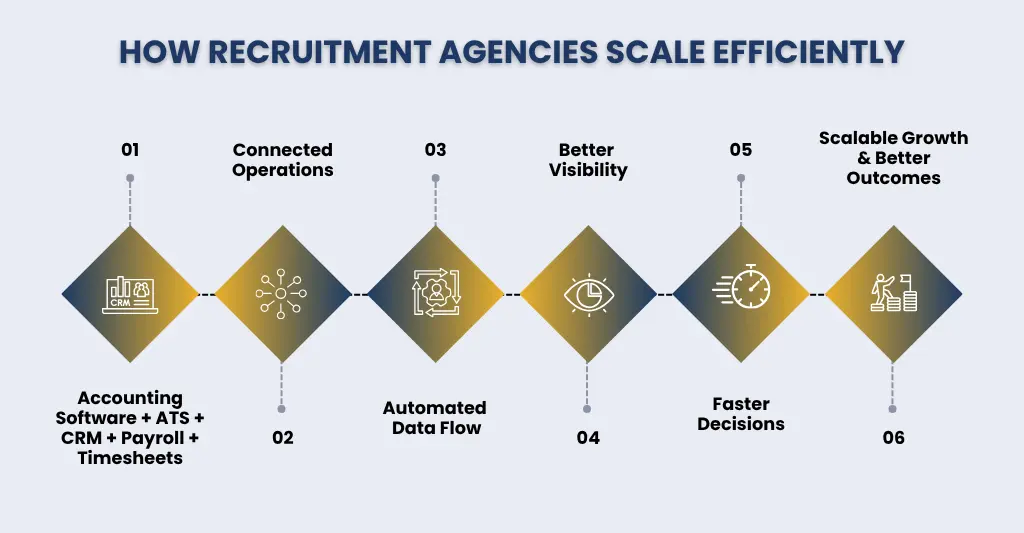
The proper technological system is crucial for recruitment firms to increase business growth, optimise operations, and enhance financial accuracy. Accounting software for recruitment companies produces a smooth workflow that minimises manual labour, guarantees compliance, and offers real-time insights when it is integrated with ATS, CRM, payroll, timesheets, and reporting tools. Agencies may increase revenue, scale effectively, and concentrate on providing candidates and clients with outstanding service by utilising these integrated solutions. It is now a strategic requirement for contemporary recruitment agencies to invest in the appropriate tech environment.
How You Can Ensure the Right Choice & Integration
The first step for recruitment companies should be choosing the right accounting and recruitment technology. Ensuring proper integration is equally important for maximising efficiency. E2E’s recruitment accountants play a key role in this process by understanding your agency’s workflow, identifying the most suitable accounting software, and integrating it seamlessly with your existing tools such as ATS, CRM, payroll, and timesheet systems.
Our team ensures that data moves between systems seamlessly, minimising manual entry, eliminating mistakes, and providing real-time insight into operational and financial performance. Book a call with E2E to optimise your IT ecosystem and help your agency scale operations, enhance compliance, and focus on strategic growth
People Also Ask:
What is the best accounting software for recruitment companies?
Among the top accounting software choices for recruiting firms are Xero, QuickBooks, and Sage. They assist agencies in managing their finances more effectively by providing real-time reporting, payroll management, cash flow tracking, and connectors with payroll and recruitment systems.
Can generic accounting software work for recruitment agencies?
Yes, fundamental accounting chores can be performed by generic accounting software. However, recruiting firms frequently demand extra capabilities for high-volume billing, contractor administration, and payroll, which could call for integrations or expert assistance.
How do I choose accounting software for my recruitment agency?
Select accounting software that can manage your company’s cash flow, payroll, invoicing, and reporting requirements. To increase productivity and decrease manual labour, make sure it interfaces with your timesheet, payroll, and recruitment CRM systems.
Do these software options handle UK payroll and CIS compliance?
Payroll capabilities and CIS support are available in a number of accounting software programs, including Xero, Sage, and QuickBooks. It’s crucial to determine whether the software satisfies your unique payroll and compliance needs, though, as the degree of capability varies.
Can I integrate accounting software with my ATS or CRM?
Yes, a lot of accounting software programs such as Xero, QuickBooks online, NetSuite, ZohoBooks and Sage Business Cloud can connect with CRM and ATS systems. This reduces administrative workload, expedites invoicing, enhances reporting, and automates data entry.
What reporting features should recruitment agencies look for?
Recruiting firms should search for reporting tools that offer information on month-end performance, contractor and client billing, cash flow, profitability, and payroll summaries. Real-time reporting, customisable dashboards, and export choices for management and compliance are also beneficial.
How much does accounting software for recruitment companies cost?
The provider and functionality needed determine the price of accounting software. While more sophisticated solutions with payroll, reports, and integrations can cost much more, basic plans usually start at £10 to £30 a month.
Can accounting software handle multiple currencies for international placements?
Yes, a lot of modern accounting software programs provide multi-currency transactions, which enable recruiting firms to bill customers, monitor payments, and handle finances in many nations and currencies.
