

What happens if you discover, days or even weeks after the P11D deadline has passed, that you missed it? This issue immediately raises concerns for many UK firms regarding employee tax consequences, HMRC penalties, and future steps. Fortunately, missing the deadline doesn’t have to result in a more serious compliance issue.
The good news is that you still have options even if you miss a deadline. In this blog, we will look at what happens if you miss the 2026 P11D deadline, the penalties you might incur, what you should do right away, and how to reduce the effects while maintaining HMRC compliance
When Is the P11D Deadline in 2026?
The P11D deadline for the 2025 to 2026 tax year is July 6, 2026. Employers are required to give copies of their P11D forms to employees and submit them to HMRC by this date. In addition to preventing HMRC penalties, meeting the deadline guarantees accurate reporting of employee perks and costs.
Key P11D, P11D(b) and Class 1A National Insurance Deadlines at a Glance
| Deadline | Action Required |
|---|---|
| 6 July 2026 | Submit P11D and P11D(b) forms to HMRC |
| 6 July 2026 | Provide employees with copies of their P11D forms |
| 19 July 2026 | Pay Class 1A National Insurance (by post) |
| 22 July 2026 | Pay Class 1A National Insurance (electronic payment) |
What Happens If You Miss the P11D Deadline?
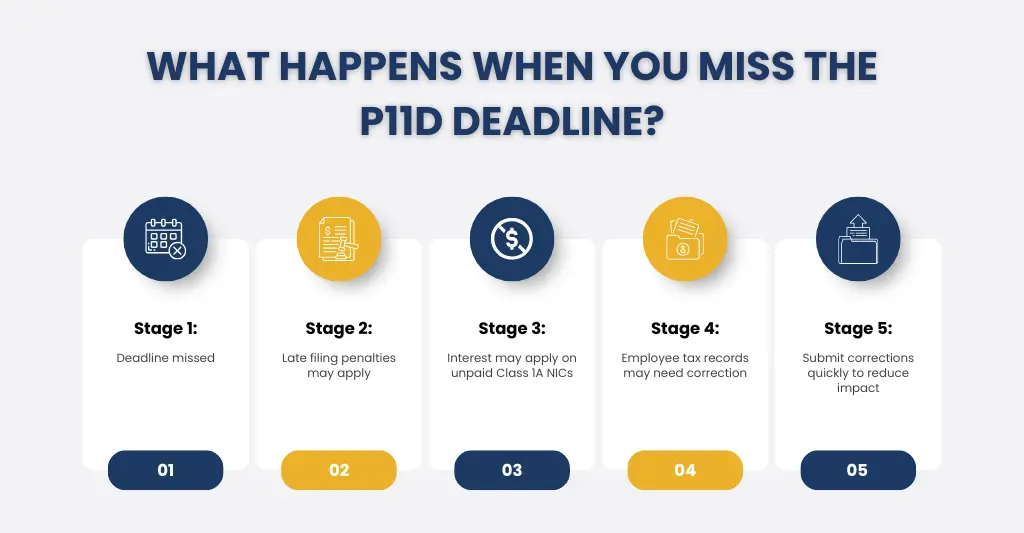
HMRC may impose late filing fines and interest on any overdue Class 1A National Insurance Contributions (NICs) if you fail to file your P11D by the deadline. The risk of more fines and compliance problems increases with the length of the delay. Submit your unfinished P11D paperwork and make any necessary payments as soon as you can to reduce the impact.
What Should Employers Do After Missing the P11D Filing Deadline?
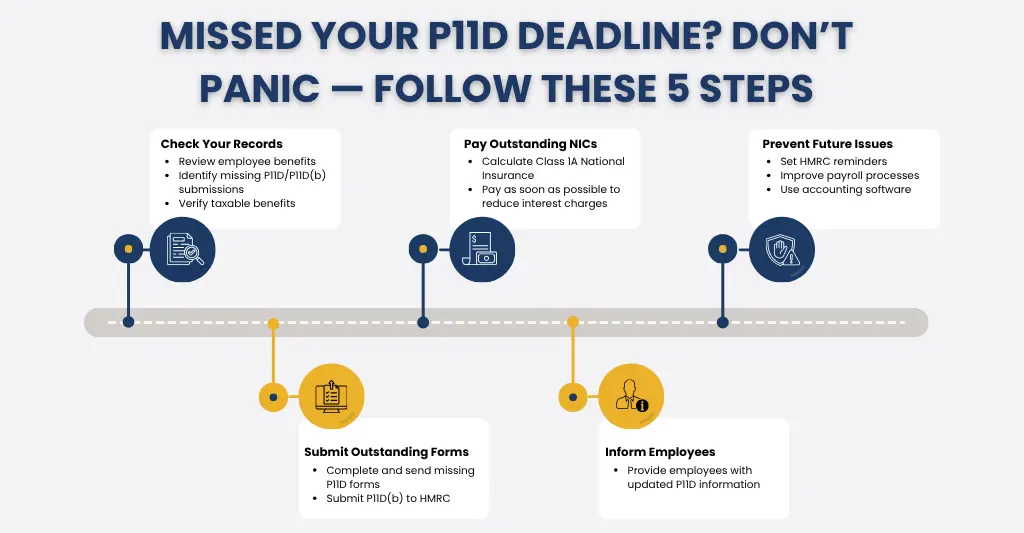
A Step-by-Step Recovery Checklist
Taking prompt action might help lower the risk of fines and further compliance problems if you have missed the P11D deadline. To get your reporting back on track, use the following checklist:
Review Your Records and Identify Missing Submissions
To determine which P11D and P11D(b) forms are still pending, start by reviewing your employee benefit information. Before submitting, make sure all information is correct by reviewing specifics like business cars, private health insurance, loans, and other taxable perks.
Submit Outstanding P11D and P11D(b) Forms to HMRC
Fill out and send the necessary forms to HMRC as soon as possible after your records have been validated. Even if the time has already passed, submitting should still be prioritised because further delays may result in fines.
Pay Any Outstanding Class 1A National Insurance Contributions
If your reported benefits result in a Class 1A NIC liability, figure out how much is owed and pay HMRC right away. Paying as soon as possible helps avoid extra expenses because late payments may result in interest charges.
Provide Employees with Their P11D Information
To help them understand which benefits and expenses have been reported, employees should be given a copy of their P11D data. Additionally, this promotes transparency and enables staff members to promptly voice any concerns.
Keep Evidence of Your Corrective Actions
Keep track of all completed forms, payments, calculations, and correspondence with HMRC. If HMRC raises any concerns, having comprehensive documentation can help prove that you behaved responsibly.
Improve Your Compliance Process for Future Deadlines
Review your payroll and benefits reporting procedure once the problem has been fixed. Missing future P11D deadlines can be avoided by setting reminders, utilising payroll software, or contracting out payroll compliance.
What Is a P11D Form and Who Needs to Submit One?
Employers in the UK use an HMRC form called a P11D form to report taxable benefits and costs given to directors and employees that are not handled by payroll. Typical examples are private health insurance, company vehicles, interest free loans, and housing.
Employers are required to submit a P11D for every qualifying employee or director who received taxable benefits during the tax year, unless those benefits have been payrolled. Employers must additionally file a P11D(b) declaring the total value of benefits and any Class 1A National Insurance Contributions (NICs) owed if any benefits have been given. Accurately and promptly filing this paperwork helps guarantee adherence to HMRC regulations and prevents needless fines.
Common Employee Benefits That Trigger P11D Reporting
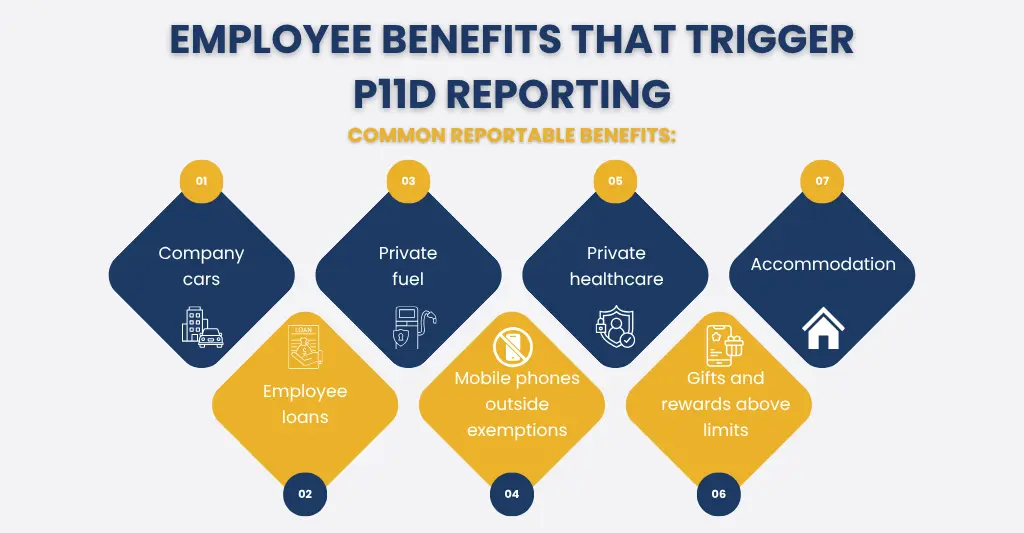
Not all employee payments must be recorded on a P11D. However, you often need to submit a P11D form to HMRC if you offer taxable perks or reimburse certain costs that aren’t handled by payroll. Depending on your sector, the precise benefits may differ, but knowing the most typical ones will help you stay in compliance and save you from expensive fines.
Construction Businesses
Due to the nature of onsite work and travel, construction companies frequently offer extra benefits to their employees. If these benefits are taxable, they may have to be disclosed. Our experienced construction accountants can review your employee benefits, ensure HMRC compliance, and help you submit accurate P11D returns on time.
Common P11D reportable benefits include:
- Company vans or cars used for private journeys
- Fuel provided for private use
- Accommodation or living accommodation allowances for site managers or temporary project staff
- Reimbursed travel expenses that don’t qualify for tax relief
- Mobile phones provided beyond HMRC exemptions
- Interest free or low interest employee loans
- Private medical insurance for senior staff
- Relocation expenses exceeding HMRC’s exempt limit
- Staff entertainment and non cash gifts above exempt thresholds
Technology Companies
To attract and retain talented workers, technology businesses usually provide competitive benefits. Many of these benefits can trigger P11D reporting requirements.
Common P11D reportable benefits include:
- Private medical insurance
- Company cars or electric vehicles with private use
- Home office equipment transferred to employees
- Interest free season ticket or equipment loans
- Employer paid gym memberships
- Relocation packages
- Living accommodation for relocated employees
- Mobile phones and broadband where exemptions do not apply
- Reimbursed personal expenses
- Non business travel paid by the employer
- Staff awards and gifts exceeding HMRC exemptions
Do you need assistance figuring out which employee benefits are subject to taxes? For professional guidance on P11D reporting, employee benefits, and HMRC compliance, consult our technology accountants.
Recruitment Businesses
Consultants and managers are frequently compensated by recruitment firms for travel and client related costs. It may be necessary to disclose some of these payments on a P11D form. Our recruitment accountants can assist you if you are not sure how to disclose employee benefits and expenses associated with hiring.
Common P11D reportable benefits include:
- Company cars and fuel benefits
- Private healthcare and dental insurance
- Interest free employee loans
- Relocation assistance
- Living accommodation
- Entertainment provided to employees rather than clients
- Employer paid subscriptions that are not exempt
- Personal travel reimbursements
- Mobile devices provided outside exempt conditions
Hospitality Businesses
Many employee benefits offered by hotels, restaurants, bars, and hospitality organisations may be subject to P11D reporting regulations. Are you having trouble reporting employee awards, business cars, or staff housing? You can avoid expensive HMRC penalties and effectively manage P11D obligations with the assistance of our hospitality accountants.
Common P11D reportable benefits include:
- Staff accommodation provided at reduced or no cost
- Company vehicles for management staff
- Private fuel provided with company cars
- Private medical insurance
- Complimentary memberships or leisure facilities
- Interest free employee loans
- Employer paid personal travel
- Gifts, vouchers, and reward schemes exceeding HMRC exemptions
- Reimbursed personal expenses
Property Businesses
Property developers, estate agencies, and property management companies frequently provide benefits to employees that may require P11D reporting.
Common P11D reportable benefits include:
- Company cars and fuel cards
- Accommodation provided to property managers
- Interest free loans
- Private healthcare
- Employer funded parking not covered by exemptions
- Relocation expenses above exempt limits
- Mobile phones and communication allowances outside HMRC rules
- Personal travel expenses
- Club memberships that are not wholly business related
- Assets transferred to employees at below market value
Still have questions about P11D benefits? Just reach out to our property accountants; they’ll be happy to assist with your P11D filing.
Medical Businesses
Employment benefits are frequently included in competitive compensation packages offered by pharmacies, dental offices, medical practices, and other healthcare providers.
Common P11D reportable benefits include:
- Private medical insurance for employees and directors
- Company cars provided to practice managers or senior staff
- Fuel for private use
- Interest free or low interest loans
- Living accommodation for on call staff where taxable
- Employer paid professional subscriptions that are not HMRC approved
- Mobile phones or electronic devices outside exempt rules
- Childcare benefits that do not qualify for exemption
- Reimbursed personal expenses
- Staff gifts, vouchers, and incentive rewards above HMRC limits
Do you need professional guidance on how to disclose employee benefits in your medical practice? Our medical accountants can assist you in understanding your P11D obligations and guarantee timely and accurate HMRC submissions.
Common Mistakes That Lead to Missed P11D Deadlines
The P11D deadline is frequently missed due to preventable errors rather than deliberate non compliance. The following are some of the most frequent reasons:
- Delaying P11D preparation till the very last moment.
- Maintaining erroneous or partial employee benefit records.
- Failing to recognise benefits that are taxable and require reporting.
- Poor collaboration between payroll, HR, and finance teams.
- Misinterpreting the deadlines for HMRC filing and payments.
- Utilising manual procedures rather than automated accounting or payroll software.
- Developing complicated benefit plans without consulting a specialist.
Employers can considerably lower their risk of missing future P11D deadlines by keeping precise records, making advance plans, and utilising dependable payroll or accounting support.
Can You Submit or Correct a P11D After the Deadline?
Yes. If you find that a form was overlooked or contains inaccurate information, you can still submit or update a P11D after the deadline. Filing the outstanding or modified P11D as soon as feasible can help prevent further compliance concerns and further charges, even though late submissions may result in HMRC fines. Paying any unpaid Class 1A National Insurance Contributions (NICs) and maintaining documentation of the corrections made are also important.
How to Avoid Missing Future P11D Deadlines?
Planning ahead and keeping accurate records are the first steps in avoiding missing P11D deadlines. Set reminders for important HMRC dates, keep employee benefit records to date throughout the year, and routinely examine payroll data to spot taxable benefits early. Using payroll or accounting software can automate much of the reporting process and reduce human error. Working with expert accountants can help guarantee that your P11Dforms are filled out correctly and submitted on time each year if your company has complicated benefit plans.
Preparing for Mandatory Payrolling: What Employers Should Do Before April 2027
Mandatory payrolling of benefits in kind is being introduced in phases. From 6 April 2027, it becomes compulsory for a limited group of common benefits, including company cars, car fuel, vans, van fuel, and employer provided medical and dental cover. Most other benefits follow in a second phase from April 2028, while loans and accommodation remain outside the mandatory regime for now. Employers should begin preparing ahead of time to guarantee a seamless transition. What you should do is as follows:
- Review employee benefits: List all taxable benefits that are now reported on P11D forms, including beneficial loans, business vehicles, and private health insurance.
- Check your payroll software: Verify that your payroll system satisfies HMRC regulations and allows for the payrolling of benefits.
- Update payroll processes: Instead of depending solely on year end P11D submissions, update your payroll systems to incorporate benefits reporting throughout the tax year.
- Train your payroll and HR teams: Make sure employees are aware of the new reporting regulations and how payroll processes will be impacted by them.
- Inform employees: Let staff know that payrolling benefits may affect their payslips and PAYE tax deductions.
- Keep accurate records: To guarantee accurate reporting, keep current records of all employee benefits and expenses.
- Seek professional support if needed: To guarantee compliance if your company has complicated benefit plans, partner with expert payroll or accounting specialists.
See what specialist payroll costs for your agency in seconds. Then find out if your payroll is actually compliant.
How E2E Accounting Helps UK Employers Stay Compliant with P11D Reporting
It can take a lot of time to manage P11D reporting, particularly when you have to juggle employee benefits, payroll, and HMRC deadlines. By guaranteeing that P11D and P11D(b) forms are correctly completed, submitted on schedule, and fully compliant with HMRC standards, E2E Accounting assists UK firms in streamlining the entire process.
Our team supports businesses by:
- Correctly completing and submitting P11D and P11D(b) forms.
- Accurately calculating Class 1A National Insurance Contributions (NICs).
- Examining employee benefits to determine what should be disclosed.
- Assisting in the correction of erroneous or late P11D submissions.
- Advising on benefits payrolling requirements prior to the April 2027 changes.
- Lowering the chance of HMRC fines by offering continuous payroll and tax compliance assistance.
Conclusion
A long term compliance problem need not result from missing the P11D deadline. You can reduce the risk of HMRC fines and get your reporting back on track by taking rapid action, completing any pending forms, paying any Class 1A National Insurance that is due, and fixing errors as soon as possible.
Looking ahead, this is the perfect moment to examine your payroll and reporting procedures, as mandatory payrolling for a first group of common employee benefits begins in April 2027, with most other benefits following from April 2028. E2E Accounting is here to assist your company with accurate, timely, and HMRC compliant payroll and tax reporting, whether you need assistance with late P11D filings, ongoing compliance, or getting ready for the upcoming changes. Avoid needless expenses tomorrow by staying ahead of deadlines today.
FAQs: Frequently Asked Questions
What is the P11D deadline for 2026?
The 2025–2026 tax year’s P11D deadline is July 6, 2026. Employers are required to give copies of their P11D forms to employees and submit P11D and P11D(b) forms to HMRC by this date. If paying online, any Class 1A National Insurance Contributions (NICs) must be made by July 22, 2026.
What happens if I miss the P11D deadline?
HMRC may impose late filing fines and interest on any unpaid Class 1A National Insurance Contributions (NICs) if you miss the P11D deadline. Send in the unfinished forms and make any necessary payments as soon as you can to avoid further fines.
Can I submit a P11D after the deadline?
Sure. After the deadline, you can still submit a P11D. It’s crucial to submit the outstanding form and pay any Class 1A National Insurance Contributions (NICs) as soon as possible to avoid additional fines and interest, even though HMRC may impose late filing penalties.
Who needs to submit a P11D form?
Employers in the UK are required to submit a P11D form for each director or employee who received taxable perks or costs that were not paid for through payroll. Employers may also be required to pay any outstanding Class 1A National Insurance Contributions (NICs) and submit a P11D(b) if benefits have been given.
What is the difference between a P11D and a P11D(b)?
The taxable perks and costs given to a specific director or employee are reported in a P11D. A P11D(b) is a summary form that verifies the Class 1A National Insurance Contributions (NICs) owed to HMRC and declares the total benefits offered by the employer.
Does missing the P11D deadline affect employees?
Yes, a missing P11D deadline may cause HMRC to make inaccurate tax computations or changes and postpone updating an employee’s tax records. The timely correction of employees’ tax positions is ensured by filing the P11D as soon as practicable.
Do employers still need to pay Class 1A National Insurance if they miss the P11D deadline?
Yes. Missing the P11D deadline does not remove the obligation to pay Class 1A National Insurance Contributions (NICs). Employers must still pay the amount due, and late payment may result in interest and penalties from HMRC.
