

In the UK, payroll for recruitment agencies is more complicated than standard payroll. From weekly contractor payments, umbrella arrangements, to strict HMRC compliance, even a minor error can lead to penalties and cash flow issues.
Over time, when agencies grow, managing PAYE, pensions, and large payroll volumes becomes a time-consuming task. That’s the exact reason why getting payroll right is truly important – not just for compliance, but for building trust with your contractors and clients.
In this blog guide, we will understand how payroll for recruitment agency works. How you can tackle the challenges and streamline the entire process without increasing internal overhead cost.
Why is payroll uniquely complex for UK recruitment agencies?
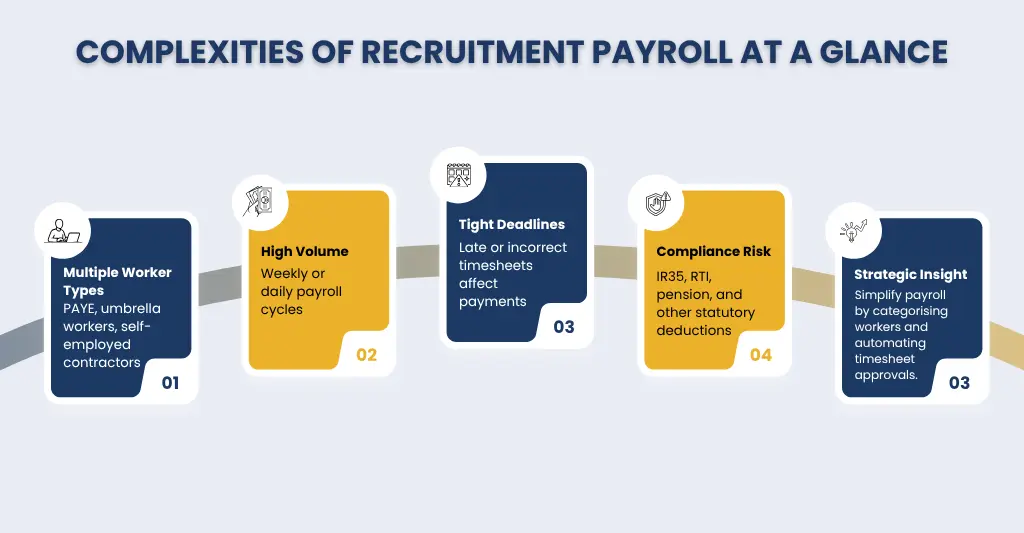
- High-volume, fast-paced payroll cycles: Recruitment agencies mostly process payroll weekly or even daily for contractors. Therefore, the time left for verification, correction or delay is very little.
For example, a UK recruitment agency managing 150 temporary workers needs to process payroll every Friday. If even 10 timesheets are submitted late or contain mistakes like incorrect working hours calculation, the payroll team may have only a few hours to rectify and correct them before payments are due. Otherwise, workers may be underpaid, overpaid, or paid late, leading to complaints and compliance risks.
- Multiple worker types and pay structures: Agencies manage employees based on the categories of – PAYE employees, umbrella workers, and self-employed contractors. They are managed based on tax rules, deductions and payment processes.
For example, the same recruitment agency managing 150 employees has 60 on PAYE, 50 under umbrella companies and 40 self-employed contractors. Then each group needs to be processed separately. PAYE employees are subject to tax and NIC deductions, umbrella employees face intermediary deductions and fees, and self-employed contractors are paid gross.
If these categories or calculations are not handled correctly in a tight weekly payroll cycle, it might result in compliance concerns, inaccurate payments, and HMRC penalties.
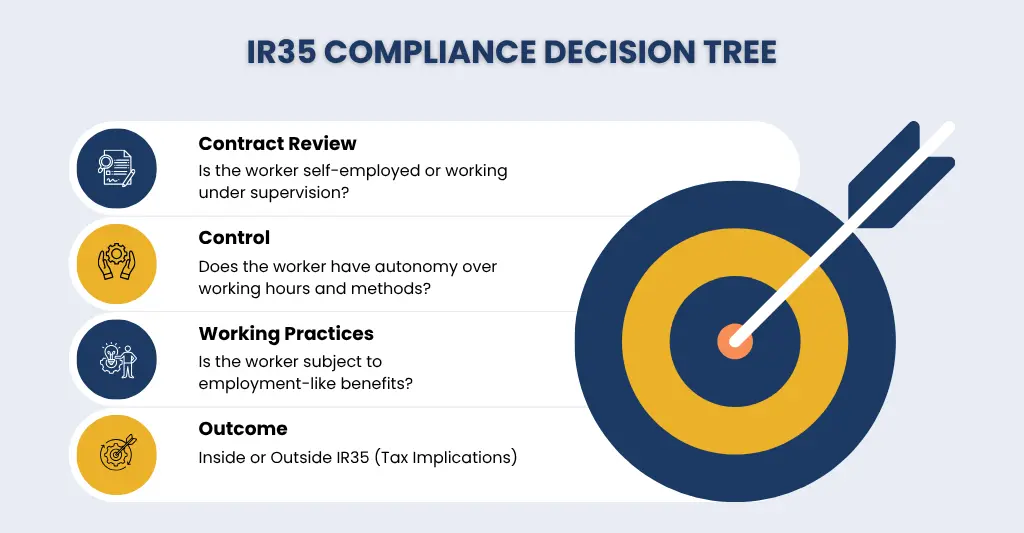
- Complex compliance requirements (IR35): IR35 is not just another rule; it’s where many agencies get stuck. You need to determine whether a contractor should be treated as employed or self-employed for tax purposes. And that decision is not always straightforward. If the agency makes a mistake, the liability doesn’t fall on the contractor; it comes back to the agency or the end client in the form of unpaid taxes and penalties.
If the same agency is handling 150 employees, and out of them, 20 contractors are engaged through Personal Service Companies (PSCs). The agency must check whether each employee falls inside or outside the IR35 category. If even 5 employees are classified incorrectly, then the agency may become liable for unpaid income tax and NICs, along with penalties and interest.
- Dependent on timesheet and approval: Payroll mostly depends on client-approved timesheets, and any delay can disrupt payment timelines and create operational pressure.
- Statutory obligations and deductions: Agencies must accurately monitor each employee’s pension, holiday pay accrual, and statutory payments. At the same time, deductions such as Income Tax, National Insurance, student loan repayments, and other adjustments (like attachment of earnings orders) must be applied accurately.
- Real-time reporting to HMRC (RTI): Payroll submissions must be reported to HM Revenue and Customs in real time, which increases the need for exact and compliant reporting.
- Direct impact on reputation and retention: Payroll errors or delays can swiftly lose contractor trust, negatively impacting retention and the agency’s reputation in a competitive market.
The 6 Biggest Payroll Problems Recruitment Agencies Face (And How to Fix Them)
- Delayed or Incorrect Timesheets: Payroll primarily depends on approved timesheets. Payments may be delayed or incorrectly processed, causing annoyance.
- Fix: Implement automated timesheet systems that include client approval protocols and deadline reminders. You can use tools such as RotaCloud or Deputy; these tools allow agencies to automate timesheet submissions, send approval reminders to clients, and track working hours in real time.
- Fix: Implement automated timesheet systems that include client approval protocols and deadline reminders. You can use tools such as RotaCloud or Deputy; these tools allow agencies to automate timesheet submissions, send approval reminders to clients, and track working hours in real time.
- IR35 Misclassification Risks: Wrong classification of IR35 can lead to tax liabilities and penalties.
- Fix: Implement organised IR35 assessments and keep comprehensive documentation for all contractors.
- Fix: Implement organised IR35 assessments and keep comprehensive documentation for all contractors.
- Cash Flow Gaps Due to Funding Delays: Agencies frequently pay contractors before receiving client payments, which causes cash flow issues.
- Fix: Align payroll with invoice factoring or funding options to better debtor management.
- Fix: Align payroll with invoice factoring or funding options to better debtor management.
- Compliance and Reporting Errors: Mistakes in RTI submission to HM Revenue and Customs might incur penalties.
- Fix: Use compliant payroll software like BrightPay, Moneysoft Payroll manager and set up a structured review process before submitting.
- Fix: Use compliant payroll software like BrightPay, Moneysoft Payroll manager and set up a structured review process before submitting.
- Managing Multiple Pay Structures: Handling PAYE, umbrella, and self-employed personnel increases the complexity and danger of errors.
- Fix: Standardise processes and integrated payroll systems that can manage numerous types of workers such as PAYE employees, umbrella workers, self-employed contractors, and contractors operating through Personal Service Companies (PSCs). This will ensure each category is processed with correct tax treatment, deductions and compliance rules.
- Fix: Standardise processes and integrated payroll systems that can manage numerous types of workers such as PAYE employees, umbrella workers, self-employed contractors, and contractors operating through Personal Service Companies (PSCs). This will ensure each category is processed with correct tax treatment, deductions and compliance rules.
- Contractor Payment Expectations: Contractors expect fast and accurate payments; delays may harm retention and reputation.
- Fix: Add buffer time to payroll cycles and guarantee clear communication with contractors.
- For example: If the payroll is scheduled every Friday, the agency can set an internal deadline for timesheet submission and approvals by Wednesday. This 1-2 day buffer will give the payroll team time to review, rectify errors and ensure accurate payments. This reduces last-minute pressure and avoids delays that could impact contractor trust.
- Fix: Add buffer time to payroll cycles and guarantee clear communication with contractors.
IR35 and Umbrella Companies: What Every Recruitment Agency Needs to Know in 2025/26
IR35 is the biggest compliance challenge faced by recruitment agencies. Under IR35, recruitment agencies need to determine whether a contractor should be treated as an employee for tax purposes. Making mistakes in this can result in tax liabilities, penalties and reputational risk.
Umbrella companies add a layer to the process. They work with contractors and handle PAYE, tax deductions, and compliance on behalf of the agency. While this can make payroll easier, it also adds risk, especially if the umbrella firm is not compliant.
Important things agencies need to watch:
- Make sure IR35 assessments are accurate and checked frequently.
- Work only with compliant and trustworthy umbrella companies.
- Keep clear audit trails and contracts for every engagement.
- Avoid schemes that promise high take-home pay.
How can you effectively manage it?
You can effectively manage IR35 and umbrella companie’s challenges by partnering with payroll and compliance experts. Implement robust onboarding checks and stay aligned with the latest guidance from HMRC to reduce risk and stay compliant.
What Does Payroll Actually Cost Your Recruitment Agency?
Payroll costs in recruitment firms are determined by volume, complexity, and compliance.
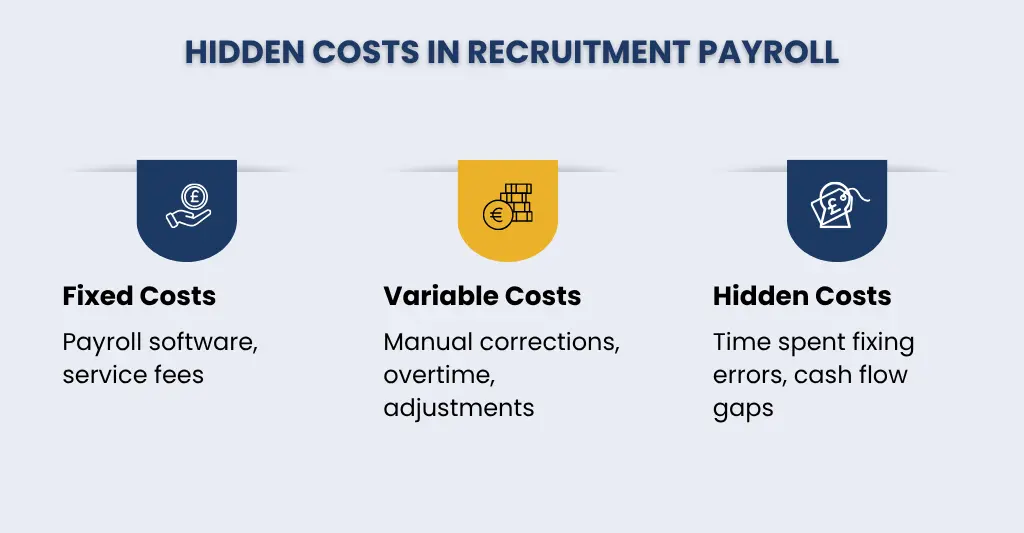
For example, if you process 50 payrolls at £19.99 each, your monthly cost already touches around £999+, and that’s just the base layer.
What Impacts Your Payroll Cost?
- The more contractors or employees you have, the more time payroll takes, especially in week one’s (weekly payroll = higher cost)
- Dynamic changes make it complicated (bonuses, overtime, adjustments)
- Handling different pay types increases work (PAYE, umbrella, CIS, limited companies) and cost.
- Manual processing is time-consuming which may increase payroll cost compared to automated processes.
- Compliance workload such as RTI submissions, pensions and following HMRC rules may impact payroll cost.
Hidden Costs Agencies Often Miss:
- Time spent fixing payroll errors
- Delays in timesheet approvals
- Cash flow gaps between paying contractors and receiving client payments
- Internal team costs (salary + training + software)
How to Reduce Payroll Costs?
- Automate payroll workflows and timesheet
- Standardise contractor payment structures
- Use scalable pricing models (pay per payslip)
- Consider outsourcing to reduce overhead by up to 60–70%
In-house vs Outsourced Payroll for Recruitment Agencies: Which Model Fits?
Choosing between in-house and outsourced payroll is not based only on cost factor; it also affects how efficiently your payroll works, how well you stay compliant, and how you can scale as the agency grows.
- In-house payroll: Having an in-house payroll gives you complete control to manage things as per your choice but, it also increases operational pressure.
- Pros:
- Direct control over payroll processes
- Quick access to data
- Customisation is based on internal workflows.
- Cons:
- Require more staff and software costs.
- Time-consuming
- Greater risk of errors and compliance issues with HMRC
- Difficult to scale during rapid growth.
- Pros:
- Outsourced payroll: This will shift the workload to experts who handle payroll, compliance, and reporting.
- Pros:
- Lower operational costs and no hiring overhead.
- Access to payroll experts and latest compliance updates.
- Scalable support as contractor volumes grow
- Reduced risk of errors and penalties
- Cons:
- Less control over day-to-day processing
- Requires choosing a reliable and compliant partner.
- Pros:
Top Payroll Software for Recruitment Agencies
Choosing the right software is not just an option; it’s a requirement for the recruitment processes that deal with high volumes, weekly payroll, and strict HMRC compliance. The right software can save hours of manual work and reduce errors.
Here’s a quick overview of payroll software for recruitment agencies.
- BrightPay: A popular choice among payroll agencies and accounting firms.
- Easy to use with strong automation
- Handles multiple clients and pay frequencies
- RTI compliant and HMRC recognised
- Includes employee self-service portals
- Best for: Recruitment agencies managing multiple payrolls and scaling operations
- Moneysoft Payroll Manager: Known for its simplicity and cost-effectiveness.
- Low-cost annual pricing model
- Handles PAYE, RTI, and statutory payments
- Suitable for small to mid-sized agencies
- Best for: Agencies looking for budget-friendly payroll software
- IRIS Payroll: Designed for payroll bureaus and larger operations.
- Manages multiple client payrolls in one system
- Built-in RTI submissions and compliance tools
- Scalable for large contractor volumes
- Best for: Growing agencies with complex payroll needs
- Xero Payroll: A cloud-based payroll software that seamlessly integrates with your accounting system. Makes payroll processing and financial management more streamlined.
- Real-time payroll processing
- Easy integration with accounting and reporting
- Ideal for digital-first agencies
- Best for: Agencies already using Xero for accounting
- Sage Payroll: A well-established UK solution.
- Strong compliance and reporting features
- Handles pensions, PAYE, and RTI
- Trusted by SMEs and accountants
- Best for: Agencies needing a reliable, all-in-one payroll system
- QuickBooks Payroll: Popular for small to mid-sized businesses.
- Seamless accounting integration
- Automated tax calculations and filings
- User-friendly interface
- Best for: Agencies wanting payroll + accounting in one platform
Conclusion
Payroll for recruiting firms is more than just a daily office task; it’s a critical operation that has a direct impact on your compliance record, the trust of your contractors and your bottom line cash flow. With messy pay systems, constant weekly processing & a whole pile of HM Revenue & Customs rules to keep in line, even a tiny bit of inefficiency can really start to cause you serious headaches.
As your agency grows, it becomes increasingly hard to handle payroll on your own without either racking up more expenses or taking on more risk. If you want to stay efficient & adaptable, a lot of firms are now turning to smarter tech, automation or outsourcing.
Why Choose E2E Payroll Services for Recruitment Agencies?
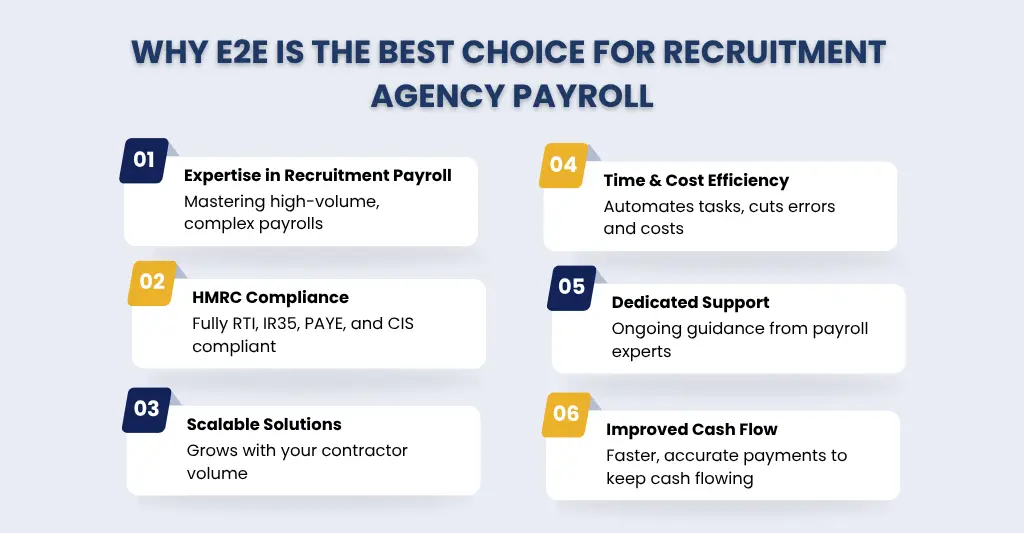
E2E Payroll Services are specifically developed for recruiting agencies that handle high-volume, weekly payrolls and complex structures such as PAYE, CIS, and umbrella employees. E2E’s comprehensive compliance with HMRC standards assures precise processing, timely RTI filings, and reduced compliance risk.
Instead of hiring and managing an in-house team, agencies can now work with experienced payroll specialists who function as an extension of their business, providing faster turnaround, fewer errors, and scalable assistance as contractor volumes increase. When partnered with expert recruitment accountants, it results in a more simplified financial ecosystem that increases cash flow visibility, lowers costs, and frees companies to focus on growth rather than administration.
People Also Ask:
What are the payroll obligations for a recruitment agency in the UK?
Payroll for recruitment agencies is not just about making payments. It includes various other things such as handling tax and NI deductions,sending RTI reports to HMRC, managing pensions, and issuing payslips on time. Above all these, they also need to handle different employee categories such as umbrella companies, CIS, and PAYE.
How does IR35 affect how a recruitment agency processes payroll?
IR35 decides how a contractor should be treated for tax. If a contractor falls under IR35, the agency must run PAYE, deduct tax and National Insurance, and update HMRC. If he doesn’t belong to IR35, the contractor is paid grossly and handles his own tax.
What are the risks of using an umbrella company for contractor payroll?
Using an umbrella company can make payroll easier, but it also comes with risks. If the umbrella is not compliant, the recruitment agency may incur tax charges, penalties, and reputational damage from HM Revenue & Customs. Sometimes, contractors can be in unclear pay arrangements where deductions and fees are not transparent.
What is weekly payroll and why do temp agencies use it?
Weekly payroll means paying employees every week rather than monthly. Contractors and temporary employees anticipate prompt, consistent payments based on authorised timesheets, thus temp agencies use it.
Can a recruitment agency be held liable for HMRC errors on contractor pay?
Yes, a recruitment agency can be held responsible for payroll irregularities, particularly if it is the fee-payer in the chain. If incorrect tax or National Insurance is deducted, or IR35 is applied incorrectly, HMRC can recover unpaid tax, interest, and penalties from the agency. This is why correct payroll processing, thorough status assessments, and partnering with compliance partners are critical.
How do I reduce timesheet errors in agency payroll?
Use automated timesheet systems such as RotaCloud and Deputy, set clear deadlines, and ensure all approvals are made before payroll. Standardising formats and performing rapid checks reduces errors and guarantees accurate reporting to HM Revenue & Customs.
Why go for E2E Accounting payroll for recruitment agency services & dedicated accountants?
E2E Accounting Recruitment Accountants specialise in recruitment payroll, IR35, and cash flow, assisting agencies in remaining compliant with HM Revenue & Customs while decreasing errors and scaling efficiently.
