

The period of the financial year ending is a time of anxiety for many business owners in the UK. Only once a month does it really mirror the financial health of their company, which is normally viewed through the rearview mirror of an annual report that is half a year old. When you discover that a given project was a drain to the organisation or that your overheads are unusually high, it is too late. You are, in fact, attempting to race without even seeing last year’s footage of the track.
But what if you could see through the windshield, not the rearview mirror? What would it be like to have a GPS in your business that will say when to step on the gas and when to step on the brakes? This is the power of monthly management accounts. These reports are not just administrative formalities; they are the strategic pulse of a thriving enterprise, providing the “real-time” data required to navigate the volatile UK economic landscape.
What Are Monthly Management Accounts?
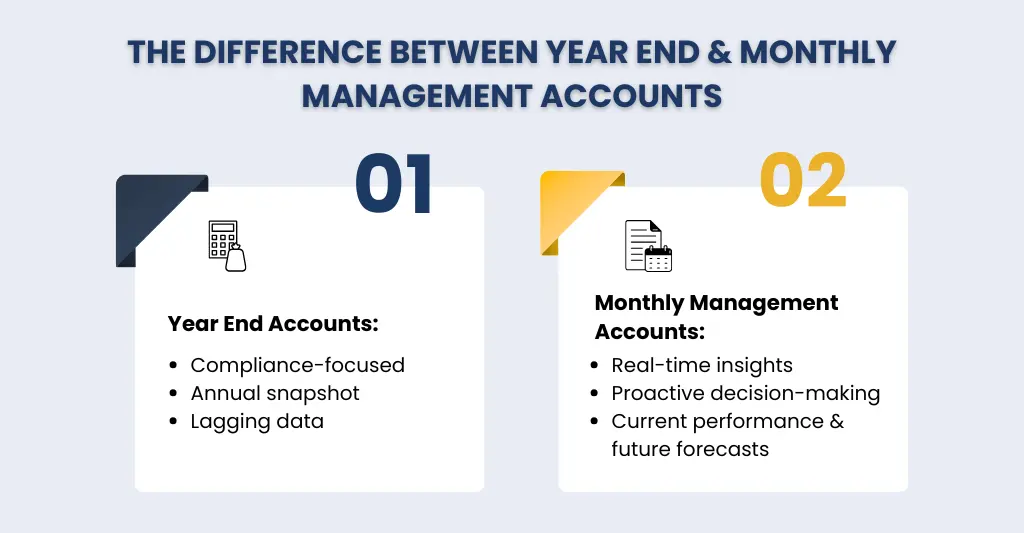
In comparison with statutory accounts, which are prepared to meet the requirements of HMRC and Companies House, monthly management accounts are prepared to meet your needs, as the owner or director of the business. They present a complete set of financial statements that evaluate the performance of a business over the last 30 days.
Whereas year end accounts are compliance-based and oriented on what has happened, management accounts are oriented on what is happening and what will happen. They fill the disjunction between basic bookkeeping and sophisticated financial planning. At E2E Accounting, we ensure these reports go beyond rows of numbers to provide a narrative of your business’s health.
A standard management pack typically includes:
- A Profit & Loss (P&L) Statement: Often broken down by department, product line, or project to show exactly where money is being made – or lost.
- Balance Sheet: Providing a snapshot of your assets, liabilities, and equity at a specific point in time.
- Cash Flow Statement: Tracking the actual movement of liquidity, which is often very different from “paper profit.”
- Key Performance Indicators (KPIs): Bespoke metrics such as gross margin percentage, debtor days, or average revenue per client.
Want to understand the difference between a Balance Sheet and Profit & Loss account? Check out our Difference Between Balance Sheet and Profit & Loss Account (With Simple Example) blog
How Monthly Management Accounts Improve Cash Flow, Profitability, and Decision-Making
To get a feel of the effects of such reports, we shall present Marcus, who owns a thriving commercial interior design company in Birmingham. Marcus was a master of landing projects, and he always had the sense that he was robbing Peter to pay Paul. His annual turnover was up to £2 million, but his bank account was frequently close to zero. He was “successful” by every traditional metric, yet he lived in constant fear of missing payroll.
By implementing monthly management accounts, Marcus gained three critical advantages that transformed his business from a source of stress into a streamlined asset.
#1. Proactive Cash Flow Management
Before management accounts, Marcus didn’t realise that his “Net 30” payment terms were actually being stretched to “Net 75” by his biggest clients. Because he only looked at his bank balance, he didn’t see the “Accounts Receivable” bubble growing.
The Outcome: This discrepancy was identified in his monthly reports. He changed his credit control policy by providing small discounts on early payments and restricting his collection policy. His cash stock tripled within four months, serving as a cushion and enabling him to negotiate better terms with his own suppliers.
#2. Identifying Profitability “Leakage”
Marcus assumed his most prestigious, high-profile projects were his most profitable. However, his monthly reports included a “Gross Margin by Project” analysis. He found out a terrible secret: on the one hand, his prestige projects brought high income, but on the other hand, the labour expenses and custom-made materials demanded so much money that his profit margin was reduced to merely 5%. Apart from this, his smaller, “dull” office remodels were at a 40% margin.
The Outcome: Marcus stopped bidding for vanity projects. He refocused his sales team on high-margin refurbishments. This enabled him to increase his bottom-line profit without raising his overall sales volume or the number of staff.
#3. Data-Driven Decision-Making
Marcus wanted to hire two new designers to expand his capacity. In the past, he would have “guessed” if he could afford them based on his current bank balance. With management accounts, he could see his Break-Even Point. He was aware of the extra amount of revenue those designers had to produce to pay their salaries, National Insurance, software licenses, and desk space.
The Outcome: He hired with confidence, knowing exactly when the investment would start paying for itself. He wasn’t gambling on growth; he was calculating it.
Monthly Management Accounts Example: Real-Life Application
Let’s look at the technical “nitty-gritty” of what Marcus’s reports actually looked like. A standard report from a provider like E2E Accounting provides a variance analysis – comparing what you expected to happen against what actually happened.
| Metric | Last Month | This Month | Variance | Strategic Insight |
| Revenue | £150,000 | £180,000 | +20% | Growth driven by new office sector demand. |
| Gross Margin | 35% | 28% | -7% | Warning: Material costs rose; check supplier contracts. |
| Debtor Days | 45 Days | 58 Days | +13 Days | Action: Credit control team needs to prioritise collections. |
| Cash on Hand | £40,000 | £12,000 | -£28k | Cash is tied up in unpaid invoices despite high sales. |
Without this monthly granularity, Marcus would have seen the £30,000 revenue jump and felt successful, completely missing the fact that his margins were shrinking and his cash was disappearing. Monthly reports allow you to catch these “silent killers” before they become terminal.
Step-by-Step Guide to Implementing Monthly Management Accounts
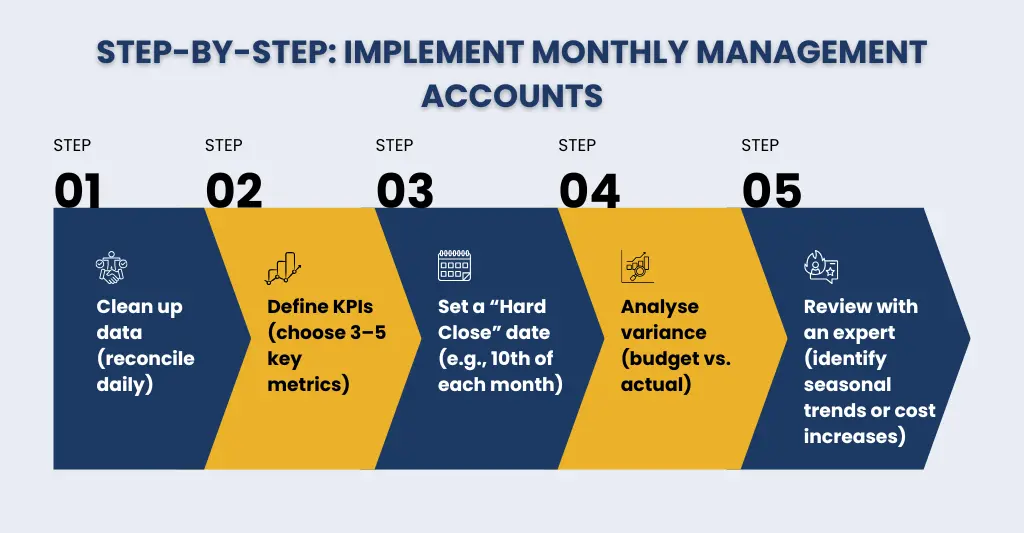
Transitioning from “year end thinking” to “monthly thinking” requires a shift in both technology and mindset.
- Clean Up the Data: Your reports are only as good as the data entering the system. Ensure your cloud accounting software (Xero/QuickBooks) is reconciled daily/weekly, depending on the need. If the data is messy, the insights will be misleading.
- Define Your “North Star” KPIs: Every business has different drivers. Is it billable hours? Occupancy rates? Conversion percentages? Work with your accountant to choose 3–5 metrics that actually move the needle.
- Set a “Hard Close” Date: Discipline is vital. Decide that by the 10th of every month, the previous month’s books must be closed, and the reports must be generated. Reports that are being delivered on the 28th are useless; you need them early enough to influence the current month.
- Analyse the Variance: Don’t just look at the numbers. Look at the difference between your budget and actual performances. If you spent £2,000 more on marketing than planned, was it a mistake, or did it result in a proportional increase in leads?
- Review with an Expert: Raw data can be overwhelming. Reviewing your reports with a professional management accountant helps you see the patterns you might miss, such as seasonal trends or creeping overhead costs.
The Cost of Monthly Management Accounts: Is It Worth It?
A common objection from SMEs is: “I can’t afford the extra accounting fees.” However, the real question is: “Can you afford the cost of ignorance?”
Consider the true costs of operating without management accounts:
- The Cost of Bad Cash Flow: Interest on emergency loans, lost supplier discounts, and the immense stress of potentially missing a payroll run.
- The Cost of Low Margins: Working 60 hours a week for a business that effectively generates no profit because you haven’t adjusted your pricing for inflation.
- The Cost of Compliance Fines: Discovering a VAT error or a payroll miscalculation a year too late results in heavy HMRC penalties.
Typically, monthly management accounts pay for themselves many times over. For a business like Marcus’s, the £800 monthly investment in high-level reporting identified £30,000 in “lost” project margins. That is a massive return on investment.
When and Why to Outsource Monthly Management Accounts
Many businesses try to do this in-house, but they often fall into the trap of “Admin Drift”—where the reports get delayed because the owner is too busy running the business. An internal bookkeeper may also lack the high-level strategic training required to interpret the data effectively.
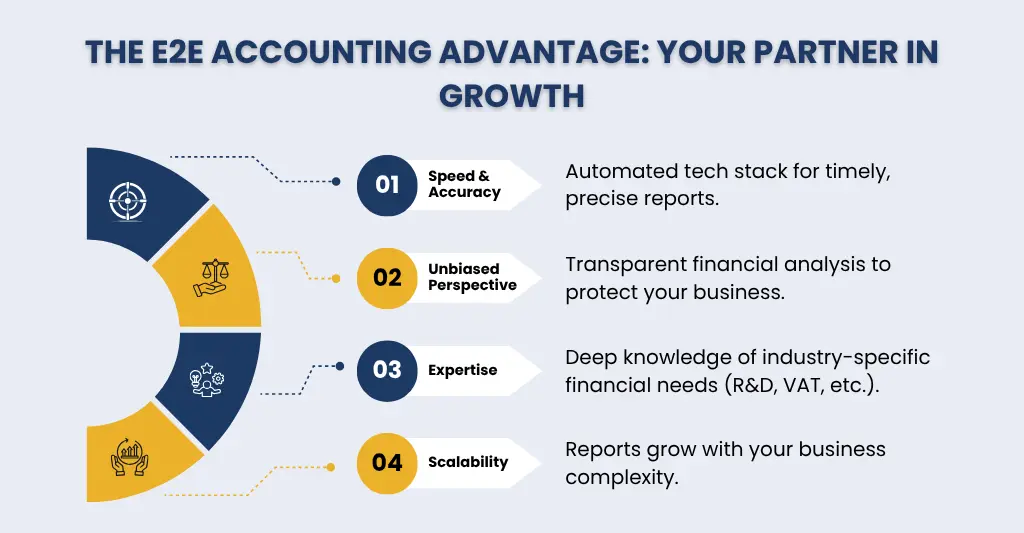
Why Outsourcing to E2E Accounting is the Ultimate Solution:
- Speed & Accuracy: We use automated tech stacks to ensure your reports are ready when you need them. We remove the human bottleneck.
- Unbiased Perspective: An internal team might “sugarcoat” the numbers to please the boss. As an outsourced partner, we provide the cold, hard truth you need to hear to protect your company.
- Deep Technical Expertise: We don’t just hand you a PDF. Our team dives into the technicalities of your sector, identifying R&D tax credits opportunities, and ensuring your VAT treatment is optimised for your specific trade.
- Scalability: As you grow, your reporting needs become more complex. We grow with you, moving from basic P&L reports to complex multi-entity consolidation and departmental forecasting.
Conclusion
In the volatile UK economy, information is the ultimate competitive advantage. Businesses that rely solely on annual accounts are operating in the dark, guessing their way through the year. Businesses that utilise monthly management accounts operate with clarity, confidence, and speed.
Marcus transformed his design firm from a cash-strapped “job” into a highly profitable, scalable “asset.” He didn’t do it by working harder; he did it by embracing the data. Whether you are looking to increase your profitability, stabilise your cash flow, or prepare for a future sale or investment, management accounts are the foundation upon which that success is built.
Partner with E2E Accounting for Strategic Growth
At E2E Accounting, we believe that every UK business owner deserves the clarity that comes with professional-grade financial oversight. We don’t just provide “accounts”; we provide the roadmap for your success. Our management accounting services are designed to turn your data into your greatest competitive advantage.
Stop guessing and start growing. Contact E2E Accounting today for a consultation on how monthly management accounts can revolutionise your decision-making and your bottom line.
