

Recruiting firms that manage a diverse workforce must be familiar with how is holiday pay calculated. Payroll is a complicated task because each worker’s entitlements might differ, from contractors to full-time employees to temporary workers. Inaccurate estimates may result in compliance problems, dissatisfied employees, and more administrative difficulties.
The purpose of this blog is to make the process easier by giving recruitment firms precise, detailed instructions on how to calculate holiday pay. You can guarantee equitable payments, uphold regulatory compliance, and effectively manage your payroll operations by adhering to these best practices.
Understanding the Basics of Holiday Pay Calculation
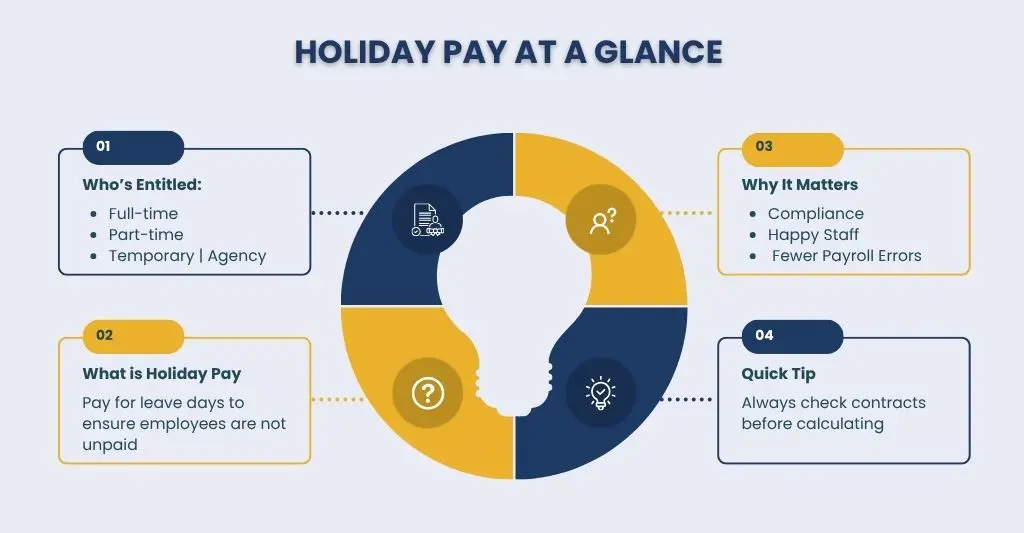
- What is Holiday Pay?
When an employee takes days off, they are compensated with holiday pay. It guarantees that workers receive pay even when they are on leave. - Who is Entitled?
Every employee in the UK, including temporary, agency, full-time, and part-time employees, is legally entitled to paid yearly leave. - Why it Matters for Recruitment Agencies
Agencies frequently supervise employees with different contracts and schedules. Accurate holiday pay computation guarantees adherence, prevents disagreements, and sustains satisfaction among workers. - How Holiday Pay is Determined?
It is typically based on an employee’s “normal earnings,” which, depending on their contract, may include commission, bonuses, overtime, or basic salary — before PAYE deductions. See our PAYE guide for how these feed into net pay. - Common Challenges
Payroll errors or underpayment may result from misinterpreting what constitutes “normal pay” or from neglecting to account for varied hours.
How Holiday Pay is Calculated for Different Worker Types
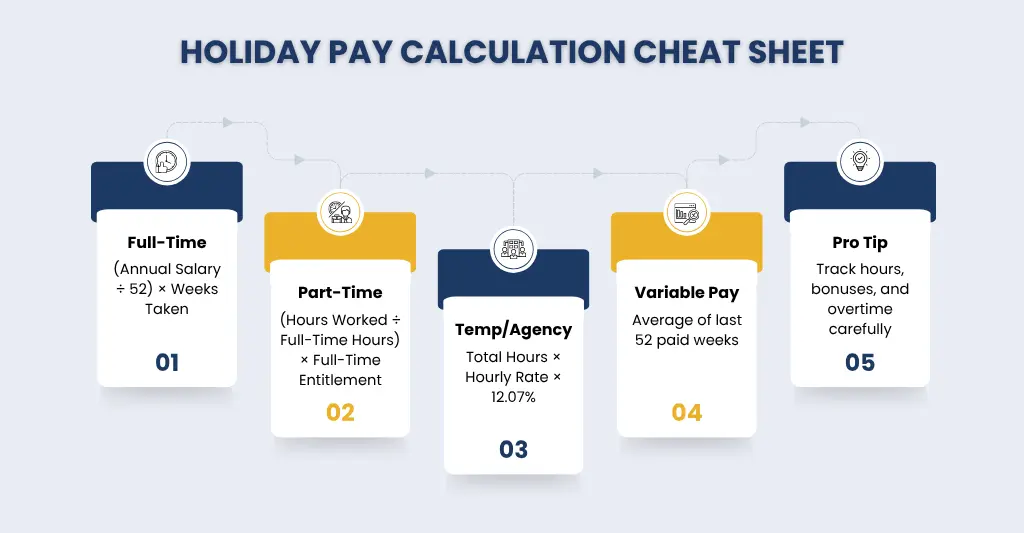
- Full-Time Employees:
- Entitled to the statutory minimum of 5.6 weeks’ paid annual leave (28 days if working a 5-day week, including bank holidays) in the UK (acc to HMRC).
- Calculation: (Annual Salary ÷ 52) × Number of Weeks Holiday Taken.
- Example: If a full-time employee earns £520 per week and takes 2 weeks off, holiday pay = £520 × 2 = £1,040.
- Part-Time Employees:
- Holiday entitlement is pro-rated based on the number of days or hours worked.
- Calculation: (Hours Worked Per Week ÷ Full-Time Hours) × Full-Time Holiday Entitlement.
- Example: If a part-time employee works 20 hours per week and full-time is 40 hours, their entitlement = 20 ÷ 40 × 28 days = 14 days.
- Agency or Temporary Workers:
- Often paid using the Working Time Regulations: 12.07% of total hours worked is used as holiday pay if leave is taken separately.
- Calculation: Total Hours Worked × Hourly Rate × 12.07%.
- Example: If a temp works 100 hours at £10/hour, holiday pay = 100 × £10 × 0.1207 = £120.70.
- Workers with Variable Pay:
- Includes commissions, bonuses, and overtime.
- Average pay from the preceding 52 weeks (or employment period if shorter) must be reflected in holiday pay.
- Ensures that employees are not penalised for income fluctuations. Details on how this is calculated are provided below.
- Key Tip for Recruitment Agencies:
- Prior to calculating holiday pay, always verify the type of contract and pay structure of the employee.
- Maintaining accurate records of hours, rates, and bonuses promotes compliance and helps prevent errors.
How is Holiday Pay Calculated for Variable Hours Workers?
Calculating holiday pay takes careful consideration for workers with variable hours, such as agency staff, zero-hour contract employees, or those on changeable shifts. Holiday pay must be commensurate with their average wages because, unlike fixed-hour workers, their income fluctuates every week.
Here’s a detailed, step-by-step method:
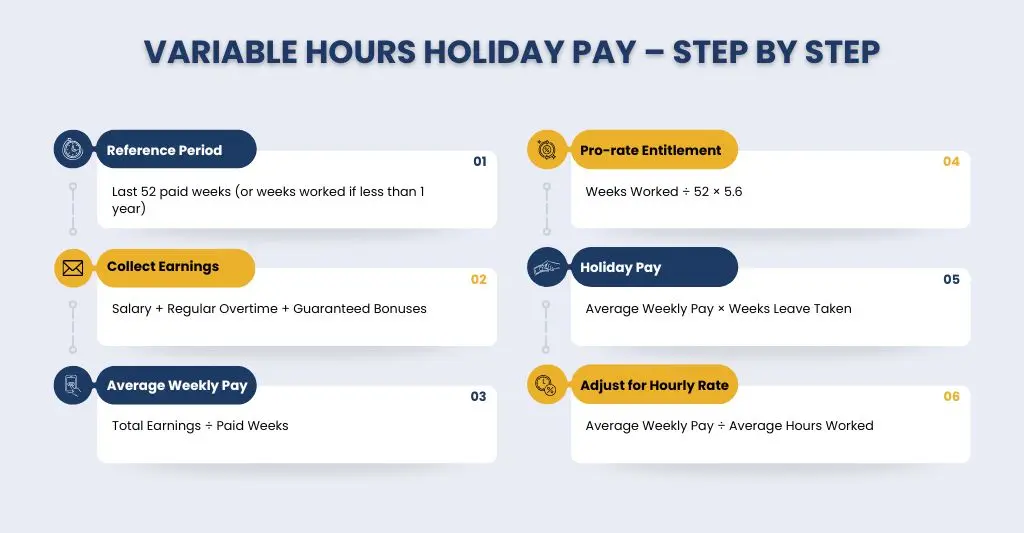
Step 1: Identify the Reference Period
The latest 52 weeks that the employee was paid are typically the reference period. Use the weeks the employee has worked if they haven’t been hired for a full year. Include only the weeks for which they were paid; unpaid time off or absences from work are not included.
Step 2: Gather All Relevant Earnings
Collect all pay that counts as “normal earnings” for the reference period, including:
- Base hourly pay or salary
- Regular overtime
- Guaranteed bonuses
Do not include: discretionary bonuses, gifts, or non-contractual payments.
Example: Jane’s pay over 48 paid weeks: £26,000
Step 3: Calculate Average Weekly Pay
- Formula: Average Weekly Pay = Total Pay in Reference Period / Number of paid weeks
- Using the example: Average Weekly Pay = £26,000 / 48 =£541.67
This ensures that holiday pay reflects what the worker normally earns.
Step 4: Determine Holiday Entitlement
Every employee in the UK is legally entitled to 5.6 weeks of paid leave annually.
Entitlement should be allocated according to the number of weeks or hours worked for part-year or irregular employment.
Example for Pro-rated entitlement: If a temporary employee worked 30 weeks a year:
Holiday Entitlement = 30/52 ×5.6=3.23 weeks
Step 5: Calculate Holiday Pay for Leave Taken
Formula: Holiday Pay = Average Weekly Pay×Number of Weeks of Leave Taken
- Example: Jane takes 2 weeks off:
- Holiday Pay = £541.67×2=£1,083.34
Step 6: Adjust for Hourly or Daily Pay
- If the worker is paid hourly, calculate the average hourly rate:
Average Hourly Rate = Average Weekly Pay / Average Hours Worked Per Week - Holiday pay for leave can then be calculated as:
Holiday Pay=Average Hourly Rate×Hours of Leave Taken - Example:
- Jane works an average of 30 hours per week.
- Average hourly rate = £541.67 ÷ 30 = £18.06/hour
- Holiday for 2 weeks (60 hours) = 60 × £18.06 = £1,083.60 (rounded)
Rolled-Up Holiday Pay: What You Need to Know
For temporary or agency workers, a technique known as “rolled-up holiday pay” is occasionally employed, in which holiday pay is integrated into the worker’s hourly or daily rate instead of being paid separately when leave is taken. Even though it could seem practical, there are significant guidelines and risks to be aware of.
What is Rolled-Up Holiday Pay?
Workers receive an extra percentage added to their usual salary during their employment, rather than merely receiving holiday pay when they take time off. Their statutory holiday entitlement is represented by this additional sum.
- For example:
- Hourly rate: £12 per hour
- Holiday pay percentage: 12.07%
- Rolled-up holiday pay: £1.45 per hour
- Total hourly pay: £13.45 per hour
This means that instead of receiving vacation pay during annual leave periods, the employee receives holiday pay on each payslip.
Step-by-Step Calculation of Rolled-Up Holiday Pay
Step 1: Calculate Total Earnings
Determine the worker’s total earnings before holiday pay is added.
- Example:
- Hours worked in a week: 40
- Hourly rate: £12
- 40×£12=£480
Therefore, Total weekly earnings = £480
Step 2: Calculate Holiday Pay Percentage
Apply the 12.07% holiday pay rate.
Formula: £480×12.07%=£57.94.
Holiday pay = £57.94
Step 3: Calculate Total Gross Pay
Add holiday pay to normal earnings.
Formula: £480+£57.94=£537.94
Total gross weekly pay = £537.94
When to Use Rolled-Up Holiday Pay for Temp Workers
As said earlier, rolled-up holiday pay is most commonly used for temporary workers who have irregular work schedules, short-term projects, or inconsistent working hours. However, it should be used in the right situations only and with proper transparency.
Suitable Situations for Rolled-Up Holiday Pay
- Short-Term Temporary Assignments: Ideal for workers that are hired for brief projects or seasonal roles. Most commonly used in hospitality industries, warehouse operations, events and retail. This simplifies payments when assignments are for a few days or weeks.
For instance, a warehouse temporary employee doing a three-week Christmas contract might have their holiday payment contributed to each weekly payslip rather than being saved separately for the next leave of absence.
- Irregular or Variable Working Hours: Rolled-up holiday pay is useful for workers with irregular or variable weekly working hours. It simplifies holiday entitlement by including a percentage of earnings in each pay, ensuring workers still receive statutory holiday pay even when their hours vary.
Example:- A temp worker may work:
- 15 hours one week
- 40 hours the next week
- 25 hours after that
Holiday pay is added straight to earnings rather than recalculating leave entitlement each week.
- Multiple Assignments Across Different Clients: Throughout the year, recruitment firms frequently put employees with several clients. Rolled-up holiday pay makes things less complicated administratively when assignments change regularly. This guarantees that employees receive holiday compensation regardless of their location.
- Casual or Zero-Hour Contract Workers: Rolled-up holiday pay is often suitable for casual or zero-hour contract workers because their work schedules are not confirmed and mostly unpredictable. These types of workers are not guaranteed a fixed number of hours each week, so their earnings depend on the type of shifts they accept.
- For example:
A worker in the hospitality industry might put in 10 hours one week, 35 hours the next, and then take a few days off. The agency adds an additional percentage (often 12.07%) to each payment rather than determining holiday entitlement after each shift or assignment.
- For example:
Can Unused Holiday Pay Be Carried Over?
Yes, in some special circumstances, unused holiday pay can be carried over to the next holiday year. However, the rules will depend on the type of leave, the worker’s contract type, and the reason for not using the holiday. Recruitment agencies should clearly understand these rules to avoid payroll issues and compliance risks.
When Can Holiday Be Carried Over?
- Sickness or Long-Term Absence: If a worker is on leave for a long period due to sickness and he is not able to take the annual leave, in that case workers don’t lose their holiday entitlement. Instead, the unused holiday can be carried over to the next year.
- For example: Twenty days of yearly leave are granted to temporary employees each year.
But he/she only uses 8 due to being on sick leave. The remaining 12 days can be carried over to the next holiday year.
- For example: Twenty days of yearly leave are granted to temporary employees each year.
- Maternity, Paternity, or Family Leave: Workers on maternity leave, paternity leave, or adoption leave can carry over unused holiday leave, in case it’s unused due to personal reasons.
- Employer Refused Leave Requests: If a worker was not given a fair opportunity to take holiday, the entitlement may need to be carried over.
- For example:
- Continuous workload pressures
- Shift shortages
- Leave requests repeatedly declined
- For example:
- Contractual Agreements: Some agencies allow workers to carry forward some number of unused holidays, based on company policy or employment contracts.
- Example:
An agency contract may allow workers to carry forward up to 5 unused holiday days into the next year.
- Example:
How Does IR35 Affect Holiday Pay for Contractors?
IR35 affects whether a contractor is treated like an employee for tax purposes. It also impact holiday pay entitlements.
- Inside IR 35:
Contractors are usually paid through PAYE or an umbrella company. In this case, they may receive holiday pay either:- Separately when they take leave, or
- Included in their payslip as rolled-up holiday pay.
- Example:
A contractor earning £1,000 per week may receive an additional 12.07% (£120.70) as holiday pay.
- Example:
- Outside IR 35:
Contractors are considered to be self-employed and generally they don’t receive statutory holiday pay. They manage their own unpaid holiday.
Depending on the contractor’s IR35 status, recruitment firms should make it clear if holiday compensation is included, accrued, or not applicable.
Learn more about IR35, umbrella companies, and contractor pay in our IR35 legislation 2026 guide
Common Mistakes in Holiday Pay Calculations and How to Avoid Them
Calculating holiday pay incorrectly can lead to payroll disputes, compliance issues, and make workers unsatisfied. Recruitment agencies that handle temporary staff, contractors, and variable-hour workers must ensure calculations are accurate and transparent. Here are some of the most common mistakes and how to avoid them.
- Using Incorrect Average Pay Calculations: Many organisations calculate holiday pay only on the basis of base salary, disregarding normal bonuses, commission, and overtime. This may lead to workers being underpaid.
- How to Prevent It:
- When determining typical wages, take frequent overtime and consistent payouts into account.
- For workers with fluctuating hours, use the appropriate 52-week reference period.
- How to Prevent It:
- Miscalculating Holiday Entitlement for Variable Hours Workers: Workers with irregular work schedules often have changing hours, which makes holiday calculation more difficult. Mostly errors happen when holiday entitlements are not clear.
- How to Avoid it
- Track all hours worked accurately
- Use payroll software or automated systems for calculations
- Review entitlement regularly for fluctuating schedules
- How to Avoid it
- Incorrect Use of Rolled-Up Holiday Pay: Some agencies incorrectly include holiday pay in wages without clearly showing it on payslips or mentioning in contract letters.
- Here’s how to avoid it
- Clearly mention holiday pay on payslips
- Mention rolled-up holiday pay arrangements in contracts
- Use the correct percentage, usually 12.07%
- Here’s how to avoid it
- Not Carrying Over Eligible Holiday Leave: Workers on sick leave or maternity leave can legally carry forward unused holiday leave into the next year. If the leaves are not carried over to next year, it may create compliance issues.
- How to Avoid It:
- Maintain proper leave records
- Understand carry-over rules for sickness and family leave
- Update payroll systems regularly
- How to Avoid It:
- Confusion Around IR35 Contractors: Agencies sometimes incorrectly assume all contractors are entitled to holiday pay.
- How to Avoid:
- Verify whether the contractor is inside or outside the IR35.
- Clearly explain holiday pay arrangements before assignments begin
- Make sure contractor agreements are updated and transparent.
- How to Avoid:
Following these steps helps agencies stay compliant and avoid payroll errors. For practical strategies to streamline payroll processes, read our Optimising Payroll for recruitment agencies blog.
Expert Insights from an Experienced Recruitment Accountant at E2E Accounting UK
Holiday pay calculation for temporary, variable-hour, and contract workers can be a difficult task. But if you have proper knowledge about holiday pay and the right approach, then it becomes easy to manage. The main key to accurate holiday pay calculation is clearly defining a worker’s contract type, working hours, and any additional earnings such as overtime or bonuses.
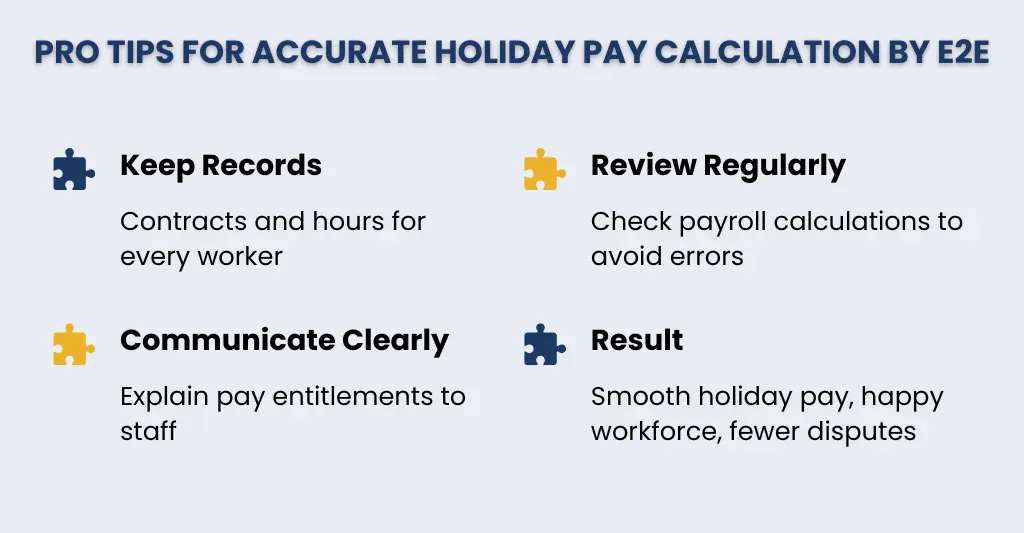
E2E Accounting’s recruitment accountants recommend maintaining clear records of workers’ contract types, keeping open communication with all staff about their pay entitlements, and regularly reviewing payroll calculations to avoid underpayment or disputes. Following these steps can make holiday pay calculation smooth, hassle-free, and help build workers’ trust.
Conclusion
Getting holiday pay right can be a tough task but it’s not impossible. Recruitment agencies just need to keep the understanding of different rules for full-time, part-time, temporary, and variable-hour workers. This clarity will help to prevent errors and improve workers’ trust and satisfaction. Often, it’s seen that agencies that handle holiday pay properly build stronger relationships with the workforce and keep business running smoothly.
People Also Ask:
How is holiday pay calculated?
The amount paid to the worker while he is on leave is known as holiday pay. It’s usually based on regular earnings or the average pay over a reference period. It can be added directly to wages as rolled-up compensation, or include incentives and overtime for temporary or variable-hour employees.
How is holiday pay calculated for zero hour contract workers?
Holiday pay for zero-hour contract workers is typically calculated as 12.07% of their earnings. Even with irregular hours, they are still entitled to holiday pay because this percentage covers statutory annual leave. For example, if a worker earns £400 in a week, their holiday pay would be £48.28.
How is holiday pay calculated for agency workers?
Holiday pay, which covers agency employees’ statutory leave entitlement, is normally calculated as 12.07% of total earnings. There are two ways to pay for this:
– Rolled-up into their hourly/daily rate, or
– Accrued separately and paid when leave is taken.
What is rolled-up holiday pay and when should it be used?
When a worker’s holiday entitlement is included as a percentage of their hourly or daily rate instead of being paid separately when they take time off, this is known as rolled-up holiday pay.
It is typically used for:
– Short-term or temporary workers
– Zero-hour or casual contracts
– Workers with irregular hours
Can unused holiday pay be carried over for agency workers?
Yes, for agency workers, unused holiday pay can generally be carried over to the next leave year, but only if it is allowed by the contract or required by law. Otherwise, any unused holiday pay should be paid out promptly.
How does IR35 affect holiday pay calculations for contractors?
A contractor is required to get the same statutory holiday pay as an employee if they are inside IR35. Holiday pay isn’t necessary if you are outside of IR35 unless the contract specifies it.
How is holiday pay calculated for variable-hour workers?
Holiday pay for employees with variable hours is often determined by averaging their salary over the previous 52 weeks of employment. This guarantees that compensation accurately represents the number of hours actually worked as well as any extra or irregular shifts.
