

Introduction
Finance function outsourcing is the process of delegating your business’s financial operations, bookkeeping, payroll, VAT returns, management accounts, and cash flow forecasting to a dedicated external team. Rather than building an in-house finance department, UK businesses work with specialist providers who manage the full finance function at a lower cost, with greater resilience, and with CFO-level insight built in.
This guide covers what to hand over, how a well-managed transition works step by step, and the exact questions you should ask any provider before you sign.
What Finance Function Outsourcing Actually Means – And What It Covers
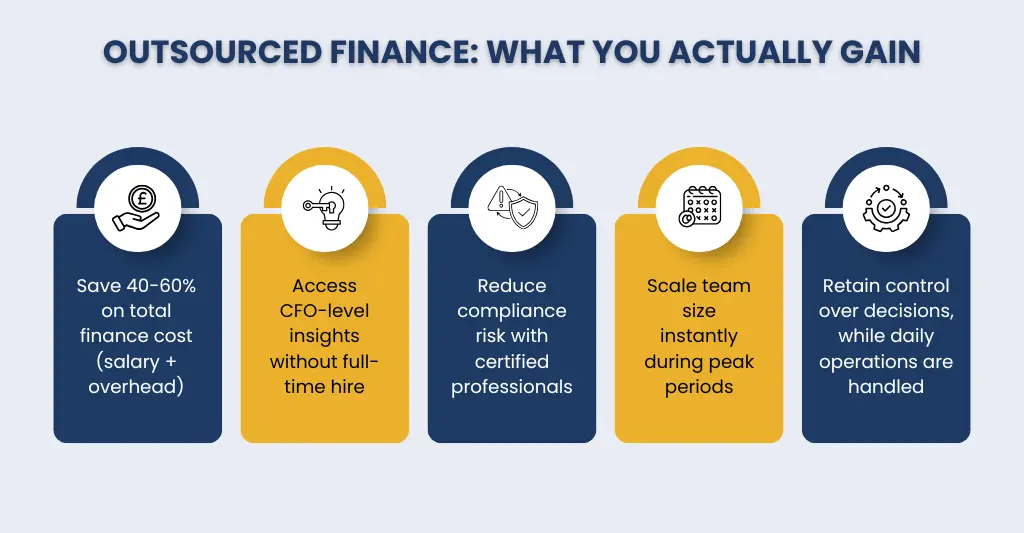
A properly scoped outsourced finance function operates as a full finance department without the headcount cost. For UK businesses, it typically includes:
- Bookkeeping and bank reconciliation: transactions recorded accurately, every month
- Accounts payable and receivable management: ensures supplier payments and client invoicing are managed to schedule.
- Payroll and PAYE: compliant payroll runs, RTI submissions to HMRC, and pension auto-enrolment.
- VAT returns: filed on time and in line with Making Tax Digital (MTD) requirements– even with the recent compulsory rollout for ITSA, as explained in our MTD for Income Tax blog.
- Management accounts: monthly P&L, balance sheet, and cash flow, so leadership has a live view of performance.
- Cash flow forecasting: forward-looking data, not just a record of what has already happened.
- Year-end support: working alongside your existing accountant in the lead-up to statutory close.
The strategic value for senior leadership is real. You gain access to financial controllers and CFO-level thinking, the kind that shapes decisions, not just reports on them, without the cost of a full-time hire.
Four Signs Your Business Is Ready to Make the Switch
Finance function outsourcing works best for growing businesses where the existing setup has quietly fallen behind.
- Your management accounts are always late or don’t exist.
If decisions are being made on last quarter’s numbers, or your bank balance is the closest thing you have to a cash flow forecast, it’s a structural issue, not a staffing one. You need timely monthly management accounts. - Finance tasks keep landing on your desk.
Processing invoices, reconciling expenses, and chasing payments are not good uses of director-level time. The cost does not appear on any report, but it compounds every week. - Growth has outpaced your current setup.
A part-time bookkeeper who worked well at a £500k turnover is not necessarily equipped for a £2.5m. More revenue means more complexity: more suppliers, more employees, changes to the VAT threshold, and greater reporting obligations. - You have no reliable forward-looking data.
Cash flow forecasting and variance analysis are not enterprise-only tools. If your current setup does not provide them, you are making decisions with less information than you need.
What the Transition Actually Looks Like: A Practical Step-by-Step
A provider with a formal orientation ensures there is not much unknown. This is how a well-managed Handover will look like:
Step 1 – Audit Your Current Finance Setup
Before contacting any provider, sketch out your finance function as it currently stands. Internal/external organisational responsibility. Which software are they using? (Xero, QuickBooks, Sage, FreeAgent? What are the deficiencies in what is being done, and what does the business really need? If this audit is accurate, so will be any proposal.
Step 2 – Define Scope Before You Scope Providers
The biggest pitfall at this point is that providers are contacted before the scope is decided, and then proposals are compared based on different metrics. Be clear about which functions are best suited to outsourcing and which to keep in-house, the reporting turnaround you require, the software stack you are on, and whether you need transactional support, strategic oversight, or both, prior to any conversation. A clear scope ensures that all the conversations are directed towards your needs.
Step 3 – Data and Systems Handover
After a provider has been chosen, the handover process begins with systematic data collection: historical accounts and previous financial data; access to accounting software; outstanding transactions; payroll history; HMRC username and password; and existing supplier agreements. The good provider performs a reconciliation review at this point to detect any gaps or errors and determine the level you are starting at before going live.
Step 4 – Onboarding Period (Typically 30-60 Days)
The onboarding phase is when the team integrates into the business. The market average is 30–60 days. At E2E Accounting, we’re able to complete onboarding in an average of 2 weeks, thanks to a dedicated team and a streamlined process, rather than a queue. Important events include agreeing on the chart of accounts and reporting format, setting up the workflows for invoices, payroll services, and VAT, and producing and signing the first management accounts pack.
Step 5 – Setting the Cadence
Clear operating rhythms are established: when the management accounts are provided, when cash flow updates are received, how HMRC deadlines are communicated and monitored, and how financial insights are shared with leadership- through monthly calls, quarterly reviews, and board packs. It’s only when outsourcing follows a regular cadence that it truly becomes a business asset.
What Happens to Your Existing Accountant?
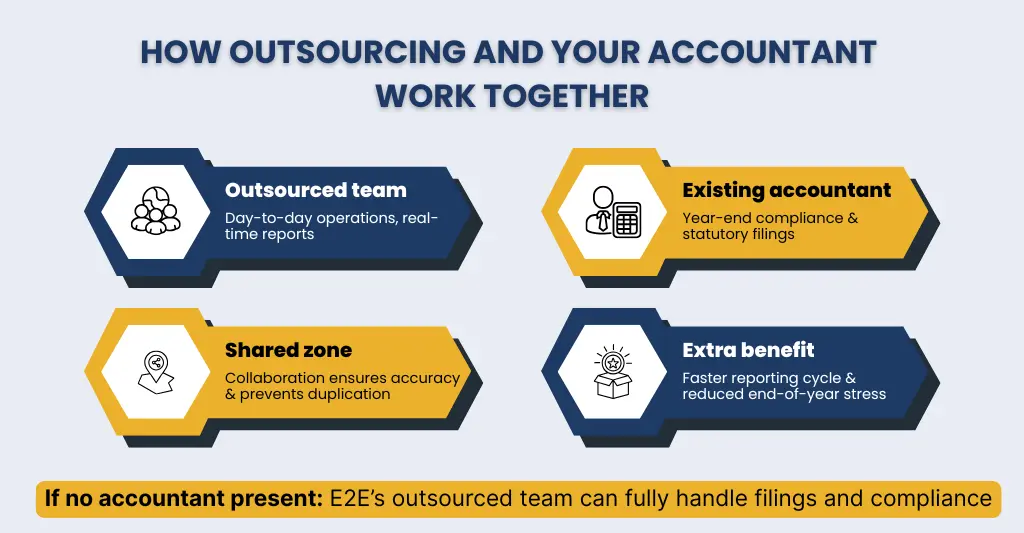
If your current accountant handles year end statutory accounts and corporation tax, they remain in place. E2E Accounting, like most professional outsourcing providers, is designed to complement a year end accountant, not replace them. The outsourced team manages everything between one year end and the next, while your accountant continues with the statutory close. Many clients find this division cleaner and more efficient than their previous setup.
If accountant also handles bookkeeping, VAT, or management accounts, there will be some overlap, and a handover will be necessary. This is a straightforward professional conversation; most accountants cooperate fully when approached directly and with reasonable notice. If finance resource is an employee, such as a bookkeeper or finance manager, redundancy or redeployment considerations must be included in the transition plan from the start, rather than addressed after committing to an outsourcing provider. E2E fulfils this gap, employing and providing the right mix that will complement your existing professionals.
Six Questions to Ask Any Finance Function Outsourcing Provider Before You Sign
The market for outsourced finance functions is not uniform. These six questions separate providers with structured operations from those without:
- Who specifically works on our account, and who covers when they are not available?
A named team with built-in holiday and sickness cover is not the same as a single point of contact who is unavailable for two weeks in August. Ask for specifics. - What does your onboarding process look like, week by week?
Providers with a defined process can walk you through it. Those without one will be vague. The quality of this answer reflects the quality of the operation behind it. - How do you manage workload during peak periods, VAT quarters, payroll runs, and year end?
Demand spikes are predictable in finance. Ask how they are handled, and what turnaround commitments exist when they occur. - What does your automation cover, and what does a qualified person still review?
Automation done well handles volume work accurately and reduces the risk of manual error. Ask what is automated, what oversight exists, and how errors are caught and corrected. - Who owns the data, and how do we access it if the relationship ends?
Your financial data belongs to you. It should be exportable in a usable format at any point. If a provider hedges on this, that is a meaningful signal. - What are your credentials and compliance standards?
ACCA-approved status, ISO 27001 certification, and the broader operational infrastructure behind a provider matter when you are handing over sensitive financial data. Ask for evidence. A credible provider will provide it without hesitation.
What It Should Cost and How to Benchmark Value, Not Just Price
The first thing companies may think of when deciding to outsource their finance function is to compare finance hires with salary data, but that is not the end of the story. The average salary for a mid-level finance manager in the UK is £55,000 to £65,000 per annum. The real cost is £75,000- £85,000/year, or around £40/hr per individual who takes holidays, falls ill, or may leave the company.
From £11 per hour, E2E Accounting provides a complete finance function. It’s not just one person, it’s a team of people, covering bookkeeping, payroll, management accounts, cash flow and VAT, backed by automation. We are also ISO 27001 approved, ACCA approved, and consist of a team of 600 people working in finance and operations. There is no disruption, with holiday and sickness cover built in. This price disparity is not a price-cutting exercise; it’s a different delivery model.
The question isn’t “What does outsource cost?” It’s “What does it cost you to do it now? Take into account the director’s time spent on finance-related tasks, decision-making without finance, and the potential for a non-scalable system. That figure will usually be higher than what you’re currently paying on your business model.
Conclusion
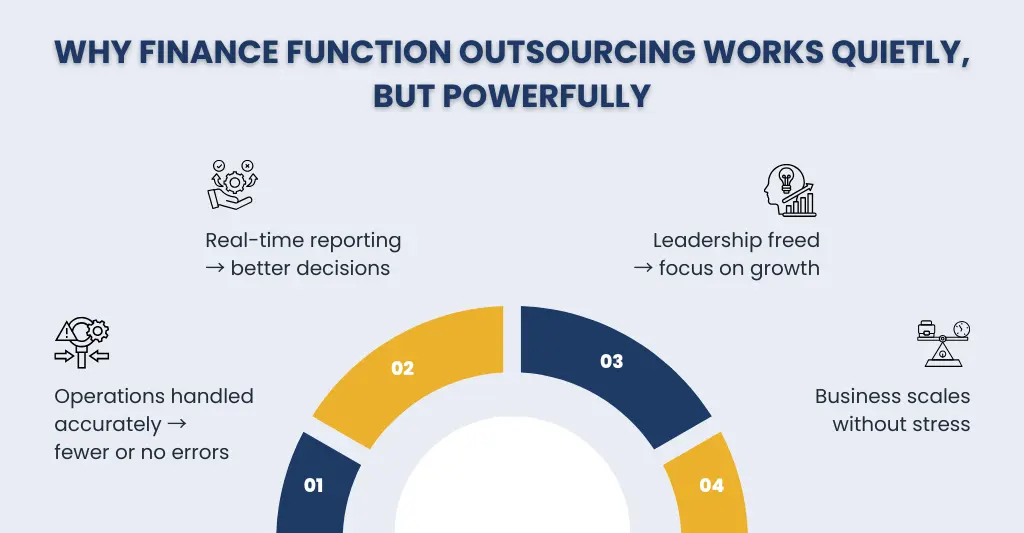
Finance function outsourcing, handled properly, is not a dramatic change. It is a quiet one. Your numbers are managed. Reporting arrives on time. Leadership gets back the hours it was spending keeping the finance function running.
The harder part is not the transition itself, but making the decision to move away from a setup that feels familiar, even when the evidence that it is no longer working is right in front of you. If you want to explore how an outsourced finance function could fit alongside your existing team, a conversation with E2E Accounting can help you understand the options – no pressure, just clarity.
People Also Ask:
What is finance function outsourcing in the UK?
Finance function outsourcing involves delegating your business’s financial functions, such as bookkeeping, payroll, VAT, management accounts, cash flow forecasting and reporting to another team. You aren’t operating an internal finance department; you are working with finance experts who are able to offer full coverage at a reduced price and with a steady quality.
When should a UK business outsource its finance function?
Common indicators include delayed or missed management reports, the finance function becoming too time-consuming, the finance function not growing to meet the needs of the business and a lack of forward-looking accounting information, such as cash flow forecasts. For growing businesses, this can be a major plus, since their finance operation can’t keep up.
How do I transition my finance function without disruption?
Plan the change: assess the current setup, establish scope, plan for data and system transfer, and select an organisation with a system onboarding process. E2E Accounting typically processes onboarding within about 2 weeks, which is quicker than the standard market time of 30-60 days.
What happens to my existing accountant when outsourcing the finance function?
The accountant you have for your year-end is likely to remain the same. E2E Accounting supports them from annual close through to the end of the year, while your accountant continues to handle statutory accounts and corporation tax. If bookkeeping or management accounts are involved, any overlap is managed easily and professionally.
What questions should I ask a UK finance function outsourcing provider?
Query about who will be working on your account, how coverage will be provided, the onboarding process, how to handle peak loads, automation and human oversight, access to data if the relationship is severed, and credentials and/or compliance standards. A dependable provider will respond to every clearly stated question.
How much does outsourcing a finance function in the UK cost?
The better comparison is with the real cost of an in-house hire. A mid-level finance manager costs £75,000–£85,000 per year, for one person. E2E Accounting’s finance function team starts at £11 an hour; they are ISO 27001 and ACCA approved, provide a full finance function, and operate within a 600-person group.
Can directors and senior management benefit from finance function outsourcing?
Yes, Directors save time in finance administration, receive timely and accurate management reporting and enjoy the benefits of financial controller and CFO-level input without a full-time financial controller or CFO. To senior leadership, it’s a big difference whether they make decisions based on accurate, forward-looking financial data or without it.
