

Meet Sarah, a UK-based businesswoman who has started selling eco-friendly household goods on Amazon. Initially, she would manually update her listings and stock up on her best-selling items to manage her inventory. However,one day she discovered: days before a major promotional event, one of her best-selling products ran out of stock, and another remained unsold in the warehouse, increasing needless storage costs.
Sarah came to understand that managing an Amazon business required more than just selling excellent products; it also required monitoring each SKU across several marketplaces and predicting consumer demand. An Amazon Inventory Management System can help with that. Sellers like Sarah may use this service to keep an eye on stock levels, automate replenishments, and make more informed decisions to increase sales and cut expenses.
In this blog, we will understand everything UK sellers need to know about Amazon inventory management systems, from their importance to how to use them successfully in 2026.
What Is an Amazon Inventory Management System?
Sellers can track, organise, and manage their inventory across one or more marketplaces with the assistance of an Amazon Inventory Management System, a kind of software. It guarantees product availability at all times, avoids stockouts or overstocking, automates re-order procedures, and offers insights into demand forecasting and sales patterns. Using such a technology helps UK merchants make more intelligent, data-driven business decisions while increasing productivity and lowering storage expenses.
Is an Inventory Management System the Same as Software?
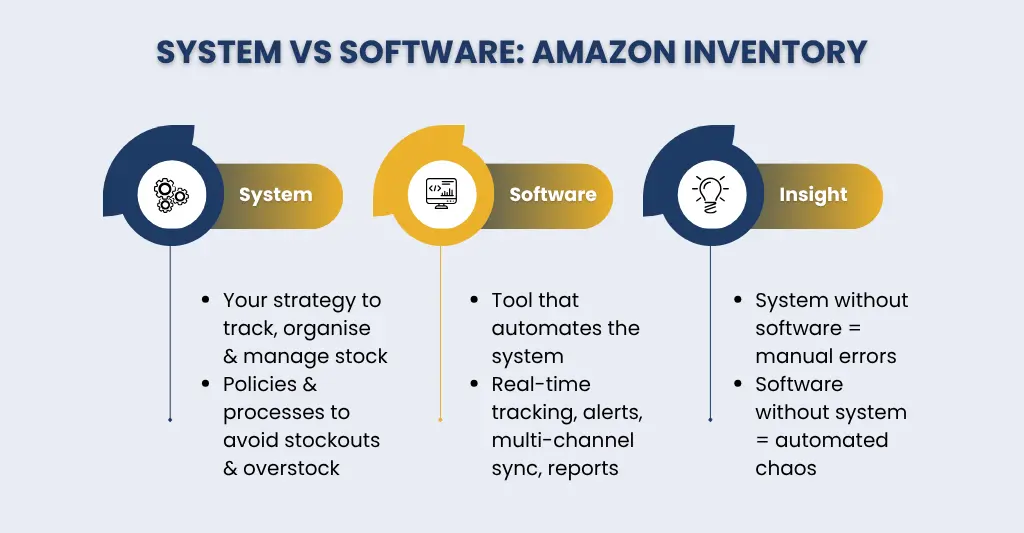
Not exactly. The entire procedure and approach utilised to monitor, arrange, and manage goods is referred to as an inventory management system. The digital instrument that streamlines and automates this process is inventory management software, which offers real-time tracking, reporting, and analytics. The software is the technology that makes the system effective and implementable, whereas the system itself is the plan.
When You Might Need Software
If you have trouble keeping track of inventory across multiple markets, frequently run out of products, experience overstock problems, or need to automate reorders and reporting, you could need inventory management software. It’s particularly useful for expanding Amazon companies that want to make data-driven inventory decisions, cut down on errors, and save time.
Does Amazon Have a Built-In Inventory Management System?
Yes, Amazon provides a basic built-in system through seller central. It has the features of tracking stock, managing listings, monitoring sales, and updating inventory. The built-in system handles fundamental tasks but growing sellers often need third-party software, as they have more advanced features like multi-marketplace tracking, automated reorders, and detailed analytics.
What Amazon’s Built-In System Includes
Basic inventory management tools including stock tracking, listing management, sales monitoring, shipment production, low-stock alerts, and inventory performance insights are all included in Amazon Seller Central. It enables sellers to do daily inventory management tasks straight from their Amazon account.
What Amazon’s System Doesn’t Do Well (UK Seller Limitations)
Amazon’s built-in system has restrictions for expanding UK businesses, even though it is helpful for basic operations. It has less forecasting power, limited multi-marketplace insight, and fewer automation options for advanced inventory planning, reporting, and reordering. Without extra software help, managing numerous sales channels or high SKU volumes can soon become challenging.
Summary & Transition
Although they might not offer the flexibility and sophisticated capabilities required for growing enterprises, Amazon’s built-in inventory management tools are an excellent spot for new sellers to start. Investing in a specialised Amazon inventory management system can assist automate procedures, increase stock accuracy, lower expenses, and facilitate wiser business choices as your operations expand. The first step in creating a more effective and successful Amazon company plan is to comprehend these distinctions.
How Does an Amazon Inventory Management System Actually Work?
There is more to inventory management on Amazon than just counting boxes. As the command centre for your products, a strong Amazon Inventory Management System (IMS) keeps delivery, orders, and stock levels on schedule. Here’s a step-by-step explanation:
- Centralising Product Data: The system collects all of your product data from various sources, such as Amazon, your website, or other marketplaces, including SKUs, descriptions, prices, and stock levels. Errors are decreased, and duplicate entries are removed with this centralised view.
- Real-Time Stock Tracking: Every time a sale takes place or stock is restocked, an IMS automatically changes inventory levels. Overselling and stockouts, which can harm your Amazon rankings and customer confidence, can be avoided with the use of this real-time visibility.
- Automated Reorder Alerts: Effective systems keep an eye on inventory thresholds and send out alerts when stock levels drop. To ensure that you never miss a replenishment opportunity, some even automatically create purchase orders.
- Integration with Fulfillment Methods: The system keeps track of which items are in Amazon’s warehouse as opposed to your own, regardless of whether you utilise Fulfilled by Amazon (FBA) or Fulfilled by Merchant (FBM). This guarantees precise reporting and seamless order fulfillment.
- Multi-Channel Inventory Synchronisation: The IMS maintains uniform stock levels for vendors who operate across marketplaces or sell on several e-commerce platforms. Selling on eBay, Shopify, or Amazon? All channels’ inventory is automatically adjusted by the system.
- Reporting and Analytics: Inventory management involves strategic as well as operational aspects. To assist sellers in making well-informed decisions, the system offers dashboards and analytics that display turnover rates, slow-moving products, and profitability per SKU. However, tracking inventory movement alone is rarely enough if profitability and margins across different products and channels remain unclear.
Key Inventory Metrics to Monitor (UK Focus)
Keeping an eye on the proper KPIs is essential to maintaining the profitability of your Amazon business, particularly in the UK, where seasonal demand, shipping times, and VAT can affect your stock strategy.
Every UK vendor should monitor the following important inventory metrics:
- Stock Levels: In short, this is the amount of inventory you have on hand for every SKU. To prevent running out or overstocking during busy times like Black Friday, Christmas, and Prime Day, it’s critical to monitor stock levels in both your warehouse and Amazon FBA in the UK.
- Sell-Through Rate (STR): Sell-through rate measures how quickly your inventory sells over a specific period. Formula:
STR = (Units Sold ÷ Average Inventory) × 100
A high STR indicates rapid product movement, whereas a low STR may indicate overstock or slow-moving merchandise.
- Reorder Point (ROP): When to replenish a product is indicated by the reorder point. Lead times from local suppliers, post-Brexit European suppliers, and international shipping delays should all be taken into account by UK vendors. Before you hit the ROP, a good IMS may notify you automatically.
- Days of Inventory (DOI): DOI indicates how long your present inventory will endure at the current rate of sales. In the UK, where demand might change as a result of marketing campaigns, public holidays, and seasonal events, this is particularly crucial.
- Inventory Turnover Ratio: This calculates the frequency of sales and replacements of inventory over time. Equation:
Cost of Goods Sold ÷ Average Inventory = Inventory Turnover
While low turnover might indicate slow sales or surplus inventory, higher turnover shows effective inventory management.
- Forecast Accuracy: Checks the degree to which your forecasts and actual sales align if you employ demand forecasting technologies. Maintaining a competitive edge in the UK Amazon market requires accurate forecasting to avoid overstocking or understocking.
- Stockouts & Backorders: Sales and a seller’s reputation can suffer from stockouts. Keep track of how frequently things run out and the number of backordered or delayed orders. If you use FBA or third-party logistics (3PL) companies in the UK, this is crucial.
5 Signs You Have Outgrown Your Current Amazon Inventory System
As your company expands, even the greatest Amazon Inventory Management System (IMS) may eventually become inadequate. It may be time for an upgrade if you’re seeing mistakes, delays, or inefficiencies. Here are five unmistakable indicators that your present system is outdated:
- Frequent Stockouts or Overstocking: Your system isn’t keeping up with demand if you frequently run out of merchandise or have extra inventory. While overstocking ties up cash and results in needless storage fees, particularly with FBA in the UK, overselling results in dissatisfied customers and lost rankings.It can also create cash flow pressure when stock purchasing decisions are not aligned with Amazon’s payout cycles.
- Manual Tracking Is Taking Over: If you find yourself relying heavily on spreadsheets, emails, or manual logs to track inventory, your system is struggling to keep up. This not only increases the risk of errors but also slows down operations, making it harder to scale efficiently.
- Limited Multi-Channel Support: Selling on eBay, Shopify, or other marketplaces in the UK? If your IMS cannot sync inventory across all sales channels, you risk overselling, stock discrepancies, and time-consuming reconciliations.
- Poor Reporting and Insights: Do you find it difficult to determine which products are trendy, slow-moving, or profitable? Often, outdated systems simply offer rudimentary information. You may make more informed decisions about pricing, procurement, and inventory by using the actionable data provided by modern IMS systems.
- Slow Order Processing or Fulfilment Errors: Consumers expect precise, prompt delivery. Orders that are mismanaged or delayed, particularly when using FBA and third-party logistics in the UK, indicate that your system isn’t capable of handling your present amount of sales.
Why Upgrading Matters for UK Sellers?
For UK sellers, updating your Amazon Inventory Management System is a crucial business decision rather than merely a nice-to-have. Here’s why.
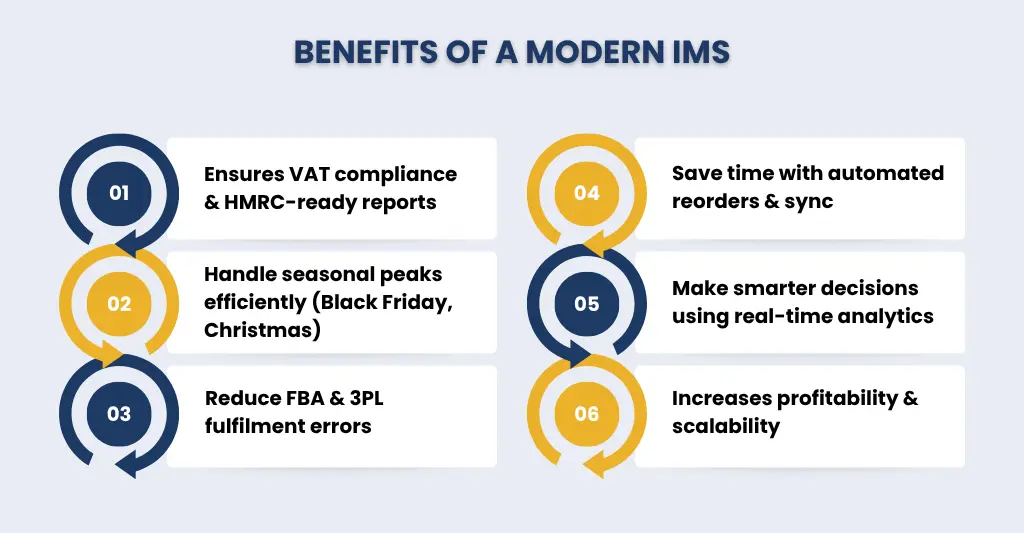
- Navigate Complex UK VAT Rules: Accurate inventory cost tracking and UK VAT-compliant report generation are two benefits of an advanced IMS. This minimises mistakes throughout tax season and guarantees seamless HMRC submissions.
- Handle Seasonal Peaks Efficiently: Black Friday, Boxing Day, and Christmas shopping are just a few of the seasonal surges that UK vendors deal with. Modern solutions assist you prevent stockouts and lost sales during times of strong demand by forecasting demand and optimizing stock levels.
- Reduce Fulfilment Errors with FBA & 3PL: Fulfillment errors might lower your seller rating. By directly integrating with Amazon FBA and other logistics companies, an improved IMS lowers human error and guarantees prompt, precise delivery.
- Save Time and Resources: Spreadsheets and manual tracking take time. Reorders, stock changes, and multi-channel synchronization are all automated by a strong system, allowing your staff to concentrate on expansion rather than administrative duties.
- Make Smarter Decisions with Real-Time Data: Analytics on product performance, inventory turnover, and sales trends are available on contemporary IMS platforms. Better pricing, more smarter marketing, and well-informed buying choices are the results for UK vendors.
How to Set Up a New Amazon Inventory Management System
Implementing an Amazon Inventory Management System (IMS) facilitates fulfilment, increases accuracy, and automates stock tracking. Here’s how to quickly set up:
- Choose the Right IMS: Select a system that supports:
- Amazon FBA integration
- Real-time stock tracking
- Multi-channel syncing
- Demand forecasting
- Accounting integration
Popular third-party tools include Linnworks, Cin7, Zoho Inventory, and SellerCloud.
- Connect Amazon Seller Central: Use API access to integrate your Amazon account so that the system can automatically sync orders, sales, inventory, and FBA stock.
- Integrate Third-Party Platforms: To maintain stock levels across all sales channels, integrate platforms such as Shopify, eBay, or WooCommerce.
- Sync Accounting Software: Use programs like Xero or QuickBooks to automate financial reporting, reconciliation, and VAT tracking. If you’re looking to streamline your finance operations, refer to our Amazon Accounting Software blog to help you choose the solution that best complements your IMS.
- Set Automation Rules: To minimise human labour and prevent stock problems, set up reorder points, low-stock notifications, and automated synchronising.
- Test and Monitor: Before going live, run test orders, verify integrations, and keep an eye on reports to make sure everything functions properly.
Tips for Smooth Transition
Making the switch to a new Amazon Inventory Management System doesn’t have to cause business interruptions. The following useful advice will help ease the transition:
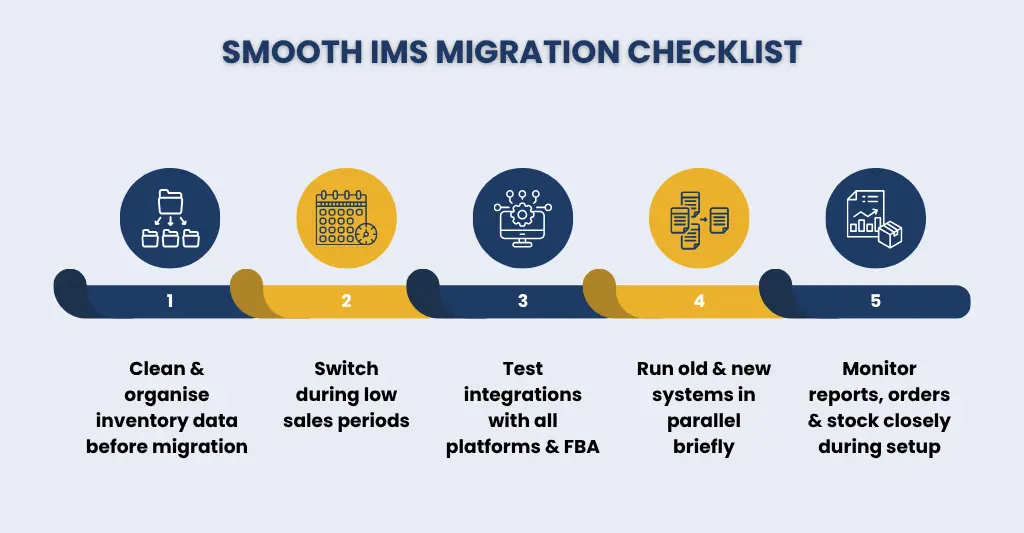
- To prevent duplicate or inaccurate information, clean up and arrange your inventory data before migrating.
- To reduce operational risks, switch to the new system during a slower sales time.
- Before launching, test integrations with third-party sales channels, accounting software, and Amazon FBA.
- To confirm order syncing and inventory accuracy, run both systems in parallel for a brief amount of time.
- Keep a close eye on reports, fulfilment procedures, and stock updates throughout the first setup stage.
Conclusion
Effective inventory management is crucial to operating a profitable Amazon business, particularly in the cutthroat UK eCommerce industry. Sellers may manage precise stock levels, expedite fulfillment, cut down on expensive errors, and increase overall operational efficiency with the help of a dependable Amazon Inventory Management System.
Upgrading to a contemporary system with automation, real-time reporting, and third-party interfaces can significantly improve profitability and scalability as your company expands. Better inventory control and more intelligent decision-making are made possible by the appropriate IMS, which also synchronises multi-channel sales and integrates with accounting software and FBA.
Investing in the best inventory management system is ultimately about creating a more robust, scalable Amazon company that is ready for long-term expansion, not just about keeping track of goods.Partnering with Amazon accountants can help you choose the right IMS that seamlessly integrates with your accounting tools, provides HMRC-compliant reporting, and supports smarter financial decision-making as your business grows.
People Also Ask:
Is Amazon Seller Central an inventory management system?
Yes, Amazon Seller Central offers basic inventory management features such as stock tracking, low-stock alerts, and inventory monitoring. These are basic features, not fully inventory management systems.
Is Veeqo an Amazon inventory management system?
Yes, Amazon owns the Veeqo inventory management system. It allows multi-channel eCommerce companies and Amazon sellers to handle orders, inventory, shipping, and warehouse operations from a single platform. Additionally, it facilitates the synchronisation of inventory across platforms such as Shopify, eBay, and Walmart as well.
What is the difference between a WMS and an inventory management system?
While a warehouse management system (WMS) manages warehouse activities like picking, packing, storage, and shipping, an inventory management system (IMS) keeps track of stock levels, orders, and product availability. To put it briefly, WMS controls warehouse processes, whereas IMS controls inventory.
How much does an Amazon inventory management system cost?
The monthly cost of an Amazon inventory management system can range from $20 for simple capabilities to several hundred dollars for multi-channel management and advanced features.
Can one system manage both FBA and FBM inventory?
Yes, a lot of inventory management systems allow merchants to effectively track stock, orders, and fulfillment using both FBA (Fulfilled by Amazon) and FBM (Fulfilled by Merchant) inventory from a single dashboard.
Is a cloud-based inventory management system better for UK Amazon sellers?
For UK Amazon sellers, a cloud-based inventory management solution is frequently preferable since it provides real-time stock tracking, remote access, multi-channel syncing, and automatic updates, all of which make inventory management simpler and more scalable.
How do UK VAT rules affect Amazon inventory management?
Amazon inventory management is affected by UK VAT regulations of inventory storage, which mandate the sellers to precisely record stock movements, sales, returns, and storage locations in order to stay compliant. Inaccurate inventory records may result in reporting problems, fines, and VAT errors.
Can one inventory system handle multiple UK marketplaces?
Yes, many inventory management systems can manage inventory across multiple sales channels from a single platform by integrating stock levels, orders, and product data across Amazon, eBay, Shopify, and other marketplaces or eCommerce platforms.
