

eCommerce sales are growing, but the profit margin doesn’t match your sales record. Does this situation sound familiar to you? Many businesses mainly focus on profit as a success metric, but revenue only shows what’s coming, not what you are actually keeping. There are some hidden costs, such as ads, returns, platform fees, and shipping, that silently eat your profit.
You need clarity, not just more sales statistics. After all expenses have been accounted for, there is clear visibility into product profitability, channel performance, client acquisition costs, and genuine margins.
In this blog, we will look at why your revenue growth may be misleading, where your margins are hiding, and how efficient eCommerce management reporting can convert your data into decisions rather than just dashboards.
What is eCommerce Management Reporting?
eCommerce management reporting is the process of recording, analysing, and presenting essential financial and operational data from your online business to help you make more informed decisions.
eCommerce management reporting is not just about maintaining basic reports; there is more to it. It integrates your sales data with costs such as advertising, shipping, platform fees, returns, and inventory, allowing you to clearly evaluate your true profitability.
What Does It Typically Include?
A well-structured eCommerce management report usually covers:
- Revenue insights – Sales by channel (Amazon, Shopify, eBay, etc.)
- Gross and net profit margins – What you actually keep after costs
- Cost breakdowns – Ads, logistics, payment gateway fees, returns
- Customer metrics – Customer acquisition cost (CAC), Lifetime Value (LTV)
- Inventory performance – Fast-moving vs dead stock
- Cash flow visibility – Money coming in vs going out
Why Revenue Growth Can Mask a Margin Problem?
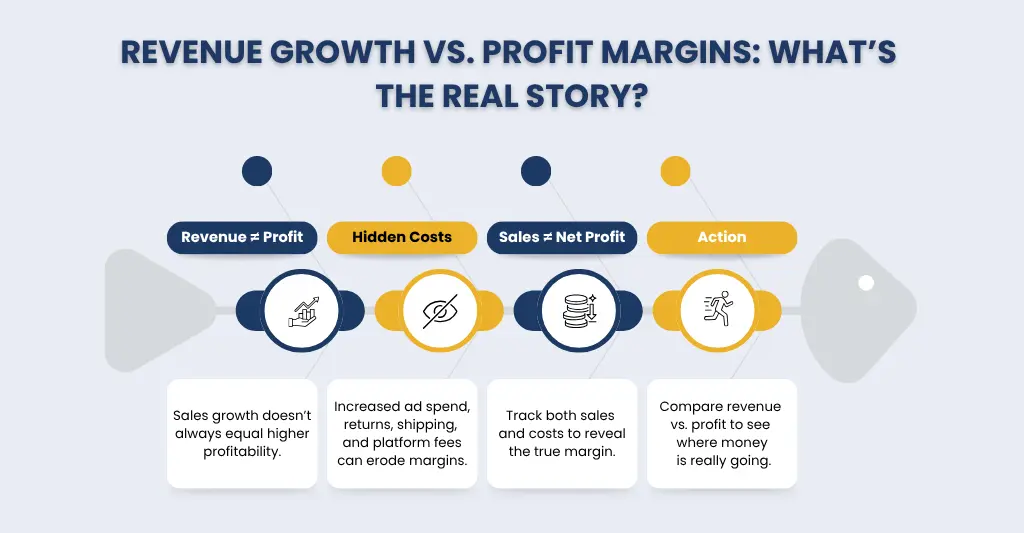
Higher sales do not mean higher profitability. Sales in eCommerce might increase, but still the profit margin may go down without you noticing it. This can happen due to increased ad spend, discounts, returns, shipping costs, and platform fees.
At first glance, looking at the statistics, the business appears to be in a good position. However, behind the scenes, additional money may be going out to boost the sales.
That’s why depending solely on revenue might be misleading. You should also track margins to determine whether your sales increase is profitable.
Why Most eCommerce Businesses Can’t See Their Own Numbers Clearly
Most of the time, eCommerce businesses are performing best, generating good sales revenue everyday, still they struggle to know their financial position. Revenue generation looks healthy on surface level but profitability and cash flow remain unclear.
Here are some of the common reasons:
- Multiple Sales Channels Create Data Silos: Financial data circulates across various systems when selling through websites, marketplaces, and social commerce platforms. It becomes challenging to provide an accurate picture of overall business performance without adequate consolidation.
- Complex Transaction Volumes: Accurately tracking and reconciling financial data can become challenging due to the thousands of daily transactions, refunds, discounts, promotions, and chargebacks.
- Cash Flow Doesn’t Match Revenue: Healthy cash flow is not usually a result of strong sales. Despite increasing income, cash shortfalls may result from delayed marketplace refunds, supplier payments, advertising charges, and shipping expenses.
- Lack of Real-Time Financial Reporting: Decision-makers are using out-of-date data rather than up-to-date financial insights when they rely on out-of-date spreadsheets or incomplete bookkeeping.
- Decision-Making Becomes Guesswork: Business owners feel pressured to make decisions about pricing, inventory, employment, and expansion based on guesswork rather than solid data in the absence of proper management accounts and financial reporting.
When Finance and Technology Work Separately, the Data Problem Gets Worse
Technology and finance function independently in many eCommerce companies. The technology team looks after eCommerce platforms, integrations, and operational systems, while the financial team concentrates on bookkeeping, reporting, and compliance. Financial visibility is made even more difficult when these functions are out of alignment.
Shopping carts, payment gateways, inventory management systems, marketplaces, CRM platforms, and accounting software all handle important data on a daily basis. Information becomes disjointed if these systems are not adequately connected, leading to gaps in reporting and decision-making.
Some common challenges include:
- Disconnected Systems Lead to Inconsistent Data: Businesses frequently end up with inconsistent statistics and inaccurate financial information when sales, inventory, and accounting platforms don’t communicate well.
- Delayed Reporting Slows Decision-Making: Financial report preparation may take days or even weeks in the absence of automated data integration. The data can already be out of date when time management examines the figures.
- Manual Data Transfers Increase Errors: Spreadsheets and manual data entry are still used by many expanding eCommerce companies to transfer data across systems. In addition to wasting precious time, this raises the possibility of expensive errors.
- Missed Opportunities for Business Growth: Businesses find it difficult to spot patterns, optimise pricing strategies, predict demand, and allocate resources efficiently when financial and operational data are not integrated.
- Lack of a Single Source of Truth: Determining whether figures are accurate can be challenging because various agencies frequently use different datasets. This leads to misunderstandings regarding cash flow, inventory levels, profitability, and sales performance.
What Good eCommerce Management Reporting Looks Like?
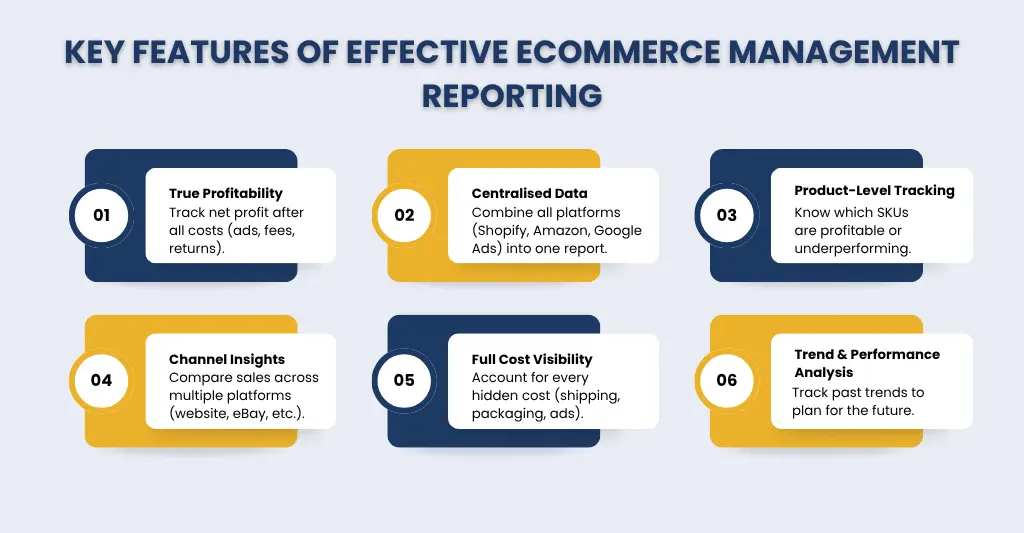
- Clear view of true profitability: Good reporting goes beyond top-line revenue to reveal your net profit. It accounts for all costs, advertising expenses, platform commissions, payment gateway fees, refunds, discounts, and shipping, so you know precisely what you are keeping.
- Centralised data in one place: Instead of managing many dashboards, all of your data is combined into a single, uniform report. This covers sales systems (Shopify, Amazon), advertising platforms, payment gateways, and logistics, providing you with a comprehensive business picture.
Want to optimise logistics costs? Check out our guide on managing VAT for logistics services.
- Product-level performance tracking: It analyses profitability through individual SKUs. You can clearly see which products have high sales but low profits, allowing you to stock inventory smartly and take pricing decisions accordingly.
- Channel-wise insights: Good reporting compares sales performance across several channels. Whether it is your website, marketplaces, or social commerce, you will get to know which channels are genuinely successful and where your marketing pounds are best spent.
- Full cost visibility: Every hidden or overlooked cost is accounted for, including advertisement, return handling, packaging, fulfilment fees, and discounts. This prevents profit margin surprises at the end of the month. (For more on optimising costs across your eCommerce operations, don’t miss our guide on the most important accounting practices for online retailers.)
- Trend and performance analysis: It doesn’t just show current figures, but also highlights past trends. You understand customer choice patterns, declining margins, or seasonal spikes and plan accordingly.
- Actionable insights, not just raw data: Instead of confusing spreadsheets, good eCommerce management reporting can tell you what actions to take. Whether you want to scale a profitable product, pause an underperforming campaign or renegotiate supplier costs.
- Focus on cash flow as well as profit: It measures not only profitability but also cash flow, allowing you to see when money is coming in and going out, as well as if your company can continue to develop.
Who Needs Specialist eCommerce Management Reporting?
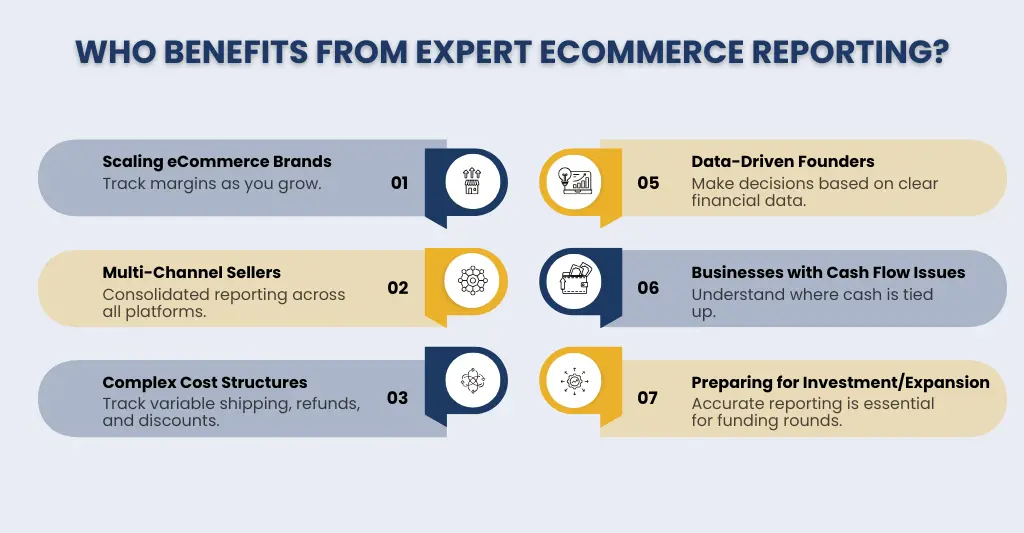
- Scaling eCommerce brands: Businesses experiencing rapid expansion frequently struggle to determine genuine profitability. Specialist management reporting enables them to analyse margins better as they grow.
- Multi-channel sellers: If you are selling on multiple platforms like Shopify, Amazon, eBay, or WooCommerce, you need consolidated reporting to track overall performance and every channel’s profitability.
- Brands with complex cost structures: If your business has variable shipping costs, refunds, discounts, or overseas sales- vat associated with it differs. This requires extensive reporting to track the true margins.
- Founders who want data-driven decisions: Business owners who wish to eliminate uncertainty and make informed decisions based on clear financial data.
- Businesses facing cash flow issues: If revenue is increasing but cash flow is tight, preparing a proper report might help determine where money is being blocked or lost.
- Businesses preparing for investment or expansion: Accurate and detailed reporting is essential when seeking funding, entering new markets, or planning an expansion.
- Teams lacking in-house financial expertise: If you do not have an in-house team, an expert finance department like that of E2E will do a good financial management and provide real-time reporting with complete transparency.
How to Set Up eCommerce Management Reporting?
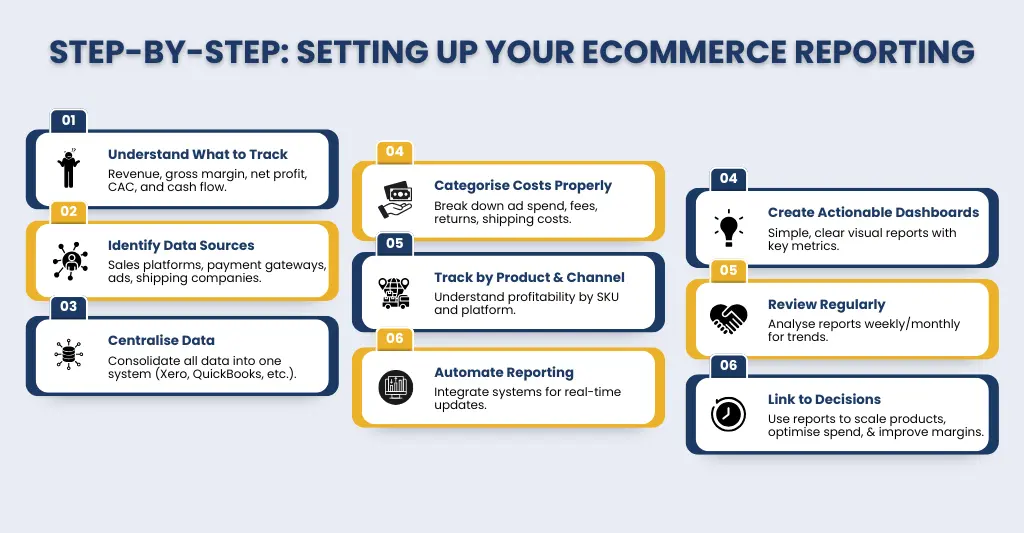
- Step 1: Understand what you need to track: Begin by determining the essential parameters that are important to your business: revenue, gross margin, net profit, Customer Acquisition Cost (CAC), return rates, and cash flow. This guarantees that your reports are focused on decisions rather than just data.
- Step 2: Identify all your data sources: Prepare a list of every platform where your data is live. Shopify, Amazon, WooCommerce, payment gateways, Ad platforms(google, meta), and shipping companies. If you miss any one data source, you may get an incomplete picture.
- Step 3: Centralise your data: Centralising your data involves consolidating all of your financial information into a single system, such as that from Xero, QuickBooks, Dextor, other eCommerce platform data, payment gateways, etc., in order to speed accounting and reduce errors.
- Step 4: Categorise costs properly: Break down all expenses, including ad spend, platform fees, shipping, returns, packaging, and operational costs. Understanding genuine margins requires proper classification.
- Step 5: Set up product and channel-level tracking: Ensure that your system monitors performance by SKU and sales channel. This allows you to determine which items and platforms are genuinely profitable.
- Step 6: Automate data collection and reporting: Make best use of the technology and ecommerce accounting software. Integrate and automate technologies to pull data regularly. This will save time and keep your reports up to date.
- Step 7: Create simple, actionable dashboards: Prepare reports that are easy to read, emphasise key metrics, trends, and trouble areas. Avoid overcomplicating with needless information.
- Step 8 Review reports regularly: Analyse your reports weekly or monthly to spot trends, identify issues early, and make timely decisions.
- Step 9 Link reporting to decision-making: Use information to take action, such as scaling profitable goods, optimising ad spend, adjusting pricing, or reducing wasteful costs.
- Step 10: Continuously refine your reporting: As your company expands, adjust your reporting structure to reflect new items, channels, and complexities. Good reporting grows alongside your business.
Where to Find eCommerce Management Reporting Experts in the UK?
If you are looking for an eCommerce management reporting expert in the UK, you must look for a firm that understands both financial data and eCommerce aspects such as platform fees, ad expenditure, and variable margins. While many firms look into analytics consultancies, eCommerce agencies, or independent consultants, the true value comes from partnering with specialists who can connect your data to real-world business outcomes.
One trustworthy choice is E2E Accounting, which specialises in providing eCommerce firms with specialised management reports that go beyond standard bookkeeping. Our eCommerce accountants focus on providing simple, actionable insights, allowing you to evaluate margins, cash flow, and performance across different channels in one place.
By automating data flows and establishing a single source of truth, our integrated accounting, software, and IT teams resolve the issue of separated systems. Additionally, you can make more informed financial decisions by using our free Profitability & Systems Review, which identifies reporting gaps and inefficiencies.
Get scalable reporting, management, and clarity for your online store by scheduling your free REVIEW right now.
Conclusion
Rising sales and earning revenue looks like a successful business. But without clear visibility into your profit margin, it can turn into confusion. That’s the reality of eCommerce businesses today. Without structured management reporting important financial information is missed. High-cost channels go unchecked, and future decisions often rely on assumptions rather than reality.
The solution to this problem is maintaining a structured report daily. It will bring clarity and confidence in your financial decisions. You can identify issues, fix them quickly, and run your business smoothly to improve performance.
Real growth is not just about selling more, it’s about building a business that is financially strong, predictable and sustainable.
People Also Ask:
What is eCommerce management reporting?
eCommerce management reporting collects, consolidates, and analyses your online business data, such as sales, costs, ads, and returns, into simple, easy-to-read reports. It enables you to monitor profit margins, identify customer patterns, and make better business decisions.
How often should I get management accounts as an eCommerce seller?
Ideally, eCommerce sellers should evaluate management accounts monthly and track important performance data frequently. Monthly reports provide a detailed view of profitability, costs, and cash flow. Whereas weekly tracking allows you to identify difficulties early, such as increased ad spend or declining margins and take immediate action.
What’s the difference between management accounts and year end accounts?
Management accounts are periodic internal reports used to monitor performance and make decisions. Year end accounts are annual reports that are used for compliance and tax reporting.
What does a channel-level P&L show?
A channel-level profit and loss statement (P&L) breaks down income and all associated costs, such as ad spend, platform fees, returns, and shipping, to illustrate which channels are profitable or losing money.
How much does eCommerce management reporting cost in the UK?
It usually costs between £150 and £1,000 per month, depending on business size, number of channels, and reporting complexity. E2E Accounting differentiates itself by providing customised reporting with real-time dashboards, automatic data consolidation from many platforms, and professional insights, all aimed at assisting UK eCommerce businesses in making faster, wiser decisions without the stress of manual tracking.
Can my existing accountant do eCommerce management reporting?
Yes, but it is not always effective. Most accountants concentrate on compliance and year end accounting, whereas eCommerce management reporting necessitates detailed, real-time information such as SKU and channel-level profitability. For more detailed and actionable reports, you may require the assistance of a specialist.
How do I get in touch with an eCommerce management reporting specialist?
You can reach UK experts like E2E Accounting via their website, email, or phone. They provide advisory services to assist Amazon, Shopify, eBay, and WooCommerce businesses in establishing accurate, timely reporting.
