

A CIS nil return is the monthly return a contractor files with HMRC to confirm that no subcontractor payments were made in a given tax month. Since 6 April 2026, filing one has been a legal requirement again, not just good practice, after HMRC reinstated the obligation as part of measures announced in the Autumn Budget 2025.
A CIS nil return keeps your records correct and your company compliant with HMRC regulations by confirming that there were no subcontractor payments or deductions during the reporting period. If one is not submitted on time, there may be fines and needless compliance issues.
This blog explains the importance of CIS nil returns, who must file them, and how contractors should avoid common mistakes.
What Is a CIS Nil Return?
A monthly CIS return (CIS300) filed for a tax month during which the contractor paid no subcontractors is known as a CIS nil return. It is simply a confirmation to HMRC that you remain a registered CIS contractor but had no subcontractor payments that month.
The nil return accomplishes the same goals as a regular return: it keeps HMRC’s records current and stops a missing return being read as non-compliance.
Why Has the CIS Nil Return Become Mandatory Again?
Nil returns were actually abolished back in 2015 as part of a CIS simplification effort. HMRC found that removing the obligation did not reduce admin for contractors or for HMRC itself. Instead, it created a wave of confusion, because many contractors assumed no payments meant no filing was needed, which led to a steady stream of penalties for missed standard returns that should have been nil returns. As part of the Autumn Budget 2025 changes, HMRC reinstated the monthly nil return requirement from 6 April 2026 to close this gap.
To increase reporting accuracy and guarantee that contractors fulfil their responsibilities even in the absence of subcontractor activity, HMRC mandates CIS nil returns. The main reasons are as follows:
Better visibility for HMRC: Nil returns enable HMRC to keep precise records of contractor activity and determine if a company has no CIS activity or has simply neglected to file a return.
Reducing compliance gaps: In the past, several contractors neglected to submit monthly CIS reports during times of inactivity, leaving gaps in HMRC’s documentation. Mandatory nil returns help fill these reporting gaps.
Confirming contractor responsibilities: A contractor can verify that they have reviewed their CIS position for the month and have no payments or deductions to record by filing a nil return.
Preventing incorrect assumptions: Many contractors think that if there are no subcontractor payments, there is no CIS action needed. By clearly stating the reporting expectation, nil returns remove this uncertainty.
Improving tax compliance monitoring: Frequent submissions enable HMRC to more efficiently uncover mistakes, incomplete data, and possible non-compliance across the construction industry.
Maintaining accurate business records: If HMRC later examines a contractor’s CIS history, a filed nil return establishes a clear compliance record.
Who Needs to Submit a CIS Nil Return?
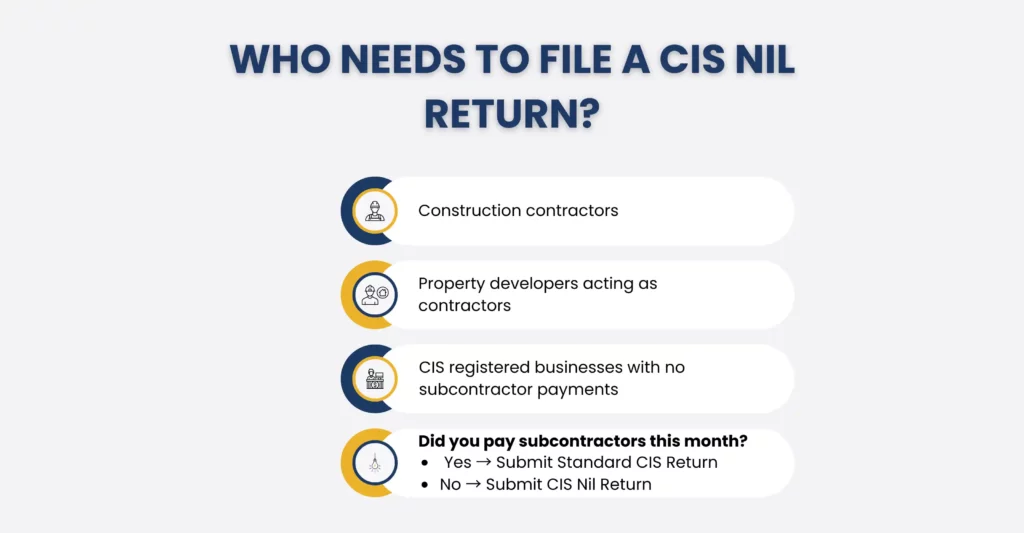
A monthly return with deductions is not filed by every company registered under the Construction Industry Scheme (CIS). To notify HMRC that no CIS activity occurred, you must typically file a nil return if you are registered as a contractor but have not paid any subcontractors during a tax month. The following types of businesses are frequently subject to this obligation.
Construction Contractors: If a construction contractor does not pay subcontractors in a given month, they are required to submit a CIS nil return. You must notify HMRC by filing a nil return even if work has stopped because of seasonal demand, project delays, or a brief shortage of subcontractors. This keeps your CIS records current and helps you avoid needless fines or compliance problems.
Property Developers Acting as Contractors: If property developers employ subcontractors to complete construction work, they may also be subject to CIS regulations. They must file a CIS nil return if they are registered as CIS contractors but do not pay subcontractors during a tax month. Timely filing guarantees ongoing adherence to HMRC’s CIS reporting requirements and confirms there was no reportable activity.
How to File a Nil CIS Return Online
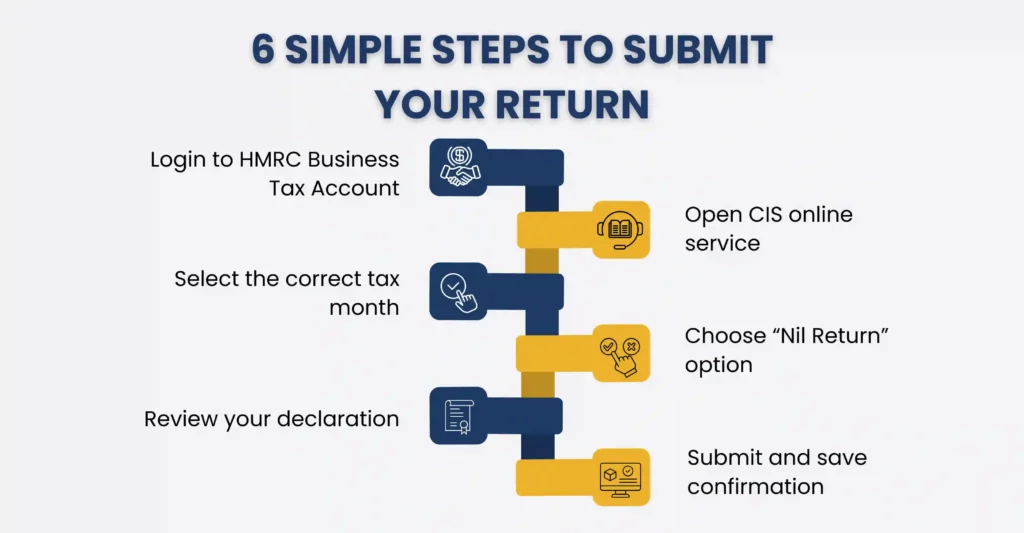
If you have not paid any subcontractors during the applicable CIS tax month, filing a nil CIS return online is straightforward. Using its online CIS service or authorised commercial CIS software, HMRC permits contractors to file a nil return. Follow these steps:
- Enter your Government Gateway ID and password to access your HMRC Business Tax Account.
- Use your business tax account to access the Construction Industry Scheme (CIS) online service.
- Choose the applicable CIS tax month for which a return is required.
- To confirm that no payments were made to subcontractors during that tax month, select the option to file a nil return.
- Check that the information in your declaration is correct by reviewing it.
- Submit the return and keep the confirmation reference as evidence of filing.
When filing your nil return, you can also use the CIS online tool to file an inactivity request if you anticipate not using subcontractors for a number of months. This lowers the chance of needless fines by temporarily suspending the monthly CIS return requirement for a maximum of six months.
What Happens If You Miss a CIS Nil Return?
When there are no subcontractor payments or deductions to report, failing to file a CIS nil return can still trigger an automatic penalty, because HMRC has no way of knowing you had no payments to report. The penalties escalate the longer a return stays outstanding:
- £100 fixed penalty, applied automatically from the first day the return is late, even if it is only one day overdue
- A further £200 fixed penalty once the return is two months late
- A tax-geared penalty of £300 or 5% of the deductions that should have been reported, whichever is greater, once the return is six months late
- An additional tax-geared penalty once the return is twelve months late, with the amount depending on whether the failure was innocent or deliberate
These penalties are charged per return, so multiple missed months mean multiple separate penalties. The consequences of missing a CIS nil return also include:
Unnecessary compliance concerns: If a contractor consistently fails to submit returns, it may be read as a sign that they are not fulfilling their CIS requirements.
Additional administrative work: Contractors frequently have to take time away from regular operations to review records, get in touch with HMRC, and resolve unresolved filing issues as a result of late filings.
Risk of further HMRC action: If CIS returns are consistently not filed, HMRC may become more vigilant and conduct more compliance checks. Since April 2026, compliance history has also become a factor in HMRC’s Gross Payment Status reviews, so repeated CIS filing failures can carry consequences beyond the direct penalty.
Impact on contractor reputation: Keeping timely and correct CIS data lowers the chance of compliance issues and shows sound financial management.
If you have a genuine reasonable excuse for late filing, such as serious illness, bereavement, or an HMRC system failure, you can appeal a penalty within thirty days of the notice. Excuses HMRC does not generally accept include forgetting the deadline, general pressure of work, or relying on an agent who filed late on your behalf.
Contractors should review their CIS reporting obligations each month and file a nil return when necessary, even in months when there are no subcontractor payments, to avoid penalties.
CIS Nil Return or Standard CIS Return: Which Should You Submit?
Whether or not you paid subcontractors during the tax month determines the type of CIS return you must file. You can avoid needless penalties and stay compliant with HMRC by filing the correct return.
Choosing Between a CIS Nil Return, Standard CIS Return, or Reviewing Your CIS Registration
Here is a simple way to decide:
| Your Situation | What You Should Do |
|---|---|
| You paid one or more subcontractors during the tax month | Submit a standard CIS return with details of all payments and deductions made. |
| Despite not paying any subcontractors throughout the tax month, you are still registered with CIS | To let HMRC know that no subcontractor payments were made, submit a CIS nil return. |
| You no longer employ subcontractors, and you do not anticipate having to pay CIS in future | Consider reviewing your HMRC CIS registration. Instead of continuing to file monthly returns, you might be able to deregister if it is suitable. |
Review your monthly subcontractor payment records if you are unsure which option applies. To make sure you fulfil your CIS duties and avoid late filing fines, seek guidance before the filing deadline if in doubt.
Common CIS Nil Return Mistakes Contractors Should Avoid
Simple errors can still generate penalties or needless letters from HMRC, despite the simplicity of a CIS nil return. Some of the most common mistakes contractors should steer clear of:
Assuming No Payments Mean No Return Is Required: Many contractors think that if they have not paid any subcontractors, they can skip submitting. For months when there are no subcontractor payments, you must still file a CIS nil return if you are registered under CIS.
Missing the Monthly Filing Deadline: Every month, the deadline for submitting CIS returns, including nil returns, must be met. Even where there is no tax payable, filing late results in automatic HMRC penalties.
Forgetting to Keep Supporting Records: You should keep accurate records that show why a nil return was filed even where no payments were made. Good records make it simpler to respond to any HMRC request for explanation.
Relying on Last Minute Filing: The chance of missing the deadline because of technical difficulties or overlooked responsibilities increases if you wait until the final day. Filing your CIS nil return early gives you more time to address any issues that arise.
How to Stay Compliant with CIS Nil Return Requirements Going Forward
Staying compliant with CIS nil return rules does not have to be difficult. Contractors can prevent missed deadlines, fines, and needless stress by taking a proactive approach.
Keep Track of CIS Filing Deadlines: HMRC must receive CIS returns, including nil returns, on a monthly basis. Keep a calendar reminder or use accounting software to track upcoming deadlines and make sure returns are submitted on time.
Maintain Accurate Subcontractor Records: Maintain accurate records of CIS deductions, invoices, verification information, and subcontractor payments. Accurate records make it easier to determine whether you must file a nil return or a standard CIS return.
Review Your CIS Obligations Regularly: As your business grows or your subcontractor usage shifts, your CIS requirements can change too. Check regularly to see whether you still need to maintain your CIS registration or if your filing requirements have changed.
Use Accounting Software to Simplify Compliance: Tracking subcontractor payments, organising records, and lowering the chance of missing CIS deadlines are all made possible by cloud accounting services. You can improve the efficiency of your monthly reporting by building CIS processes into your existing bookkeeping routine.
Seek Professional Advice When Needed: CIS regulations can be complicated, particularly if your subcontractor arrangements change. Working with an expert accountant to ensure your returns are accurate and submitted properly reduces your risk of HMRC penalties.
You can more confidently handle nil return requirements and avoid last minute filing problems by building CIS compliance into your routine financial processes.
How E2E Accounting Supports CIS Compliance
It can be difficult to maintain Construction Industry Scheme (CIS) compliance when you have to manage subcontractors, keep up with HMRC regulations, and meet project deadlines. Our skilled construction accounting experts at E2E Accounting collaborate directly with contractors and subcontractors to ensure that every part of CIS compliance is precise, timely, and stress free. We make sure your responsibilities are fulfilled without needless delays or fines, from confirming subcontractors and working out the correct CIS deductions to preparing monthly CIS returns and answering HMRC inquiries.
Our team also keeps track of legislative developments to help your company stay compliant when HMRC regulations change. Our tailored solutions reduce administrative load and increase accuracy, whether you need continuous CIS management or help with a specific compliance challenge. Visit our Construction Accountants expertise page to find out more about our specialised services for the construction sector.
Conclusion
Even in months when you have not paid any subcontractors, filing a CIS nil return has been a legal requirement since 6 April 2026, and it remains a crucial part of staying HMRC compliant.
You can avoid needless penalties, keep your CIS records current, and make sure your contractor duties are fulfilled without interruption by filing your return by the deadline.
Working with knowledgeable construction accountants can make the process considerably easier if you are unsure whether you need to file a CIS nil return, need help with monthly CIS compliance, or want to prevent costly filing errors. Our CIS experts at E2E Accounting can handle your monthly returns, keep you compliant with the latest HMRC regulations, and free up more of your time to focus on running your construction business.
FAQs: Frequently Asked Questions
What is a CIS Nil Return?
A monthly report that a contractor submits to HMRC to confirm that no payments were made to subcontractors during a CIS tax month is known as a CIS nil return. Even without subcontractor activity, it keeps your Construction Industry Scheme (CIS) records current and ensures you continue to comply with HMRC’s filing obligations.
Who needs to submit a CIS Nil Return?
CIS registered contractors who have not paid any subcontractors during a CIS tax month, but are still obligated to file a monthly CIS return with HMRC, must submit a CIS nil return. It helps ensure adherence to CIS standards and confirms there was no subcontractor activity during that period.
When is the CIS filing deadline?
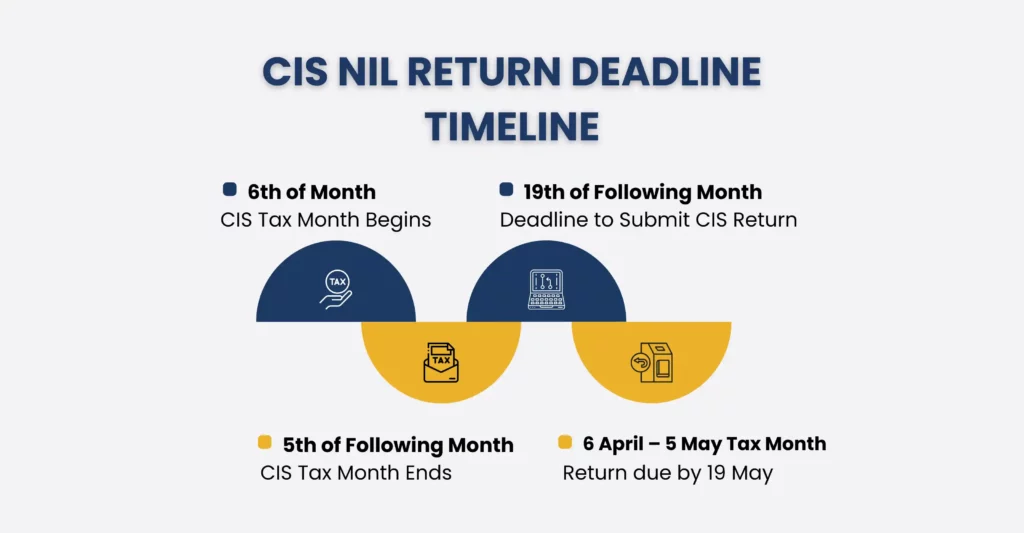
The CIS filing deadline is the 19th of every month, following the preceding CIS tax month, which runs from the sixth of one month to the fifth of the following month.
For instance, if your CIS tax month runs from 6 April to 5 May, you must submit your CIS nil return by 19 May to avoid late filing penalties. Missing this deadline triggers an automatic £100 penalty from day one, rising to £200 at two months and further tax geared penalties from six months onward.
How do I file a Nil CIS Return online?
You can submit a nil CIS return online by logging into your HMRC Business Tax Account or using authorised CIS software. Confirm that no payments were made to subcontractors, select the correct CIS tax month, choose the nil return option, and submit it before the filing deadline.
Can property developers submit a CIS Nil Return?
Yes. Property developers registered as CIS contractors can file a nil return if they did not pay any subcontractors during the applicable CIS tax month. This keeps them in compliance with HMRC’s monthly CIS filing requirements.
Should I close my CIS registration if I no longer use subcontractors?
Not always. Rather than cancelling your CIS registration, you can tell HMRC about your temporary inactivity if you stop using subcontractors. You can request that HMRC cancel your CIS registration if you are no longer required to operate under the Construction Industry Scheme, but whether this or an inactivity request is the better option depends on your future plans.
