

If you are a landlord or sole trader in the United Kingdom, your primary attention is most likely on running your business rather than preparing quarterly tax returns. The rent needs to be collected, tenants require a response, clients demand invoices, expenses pile up, and many things are happening at a fast-pace. In the middle of daily chaos, suddenly you remember about MTD Quarterly Reporting
You begin searching for bank transactions, verify receipts and wonder if that payment qualifies as a repair or capital upgrade. Also, your accounting software hasn’t been updated in weeks.
This is where real stress begins?
Quarterly reporting isn’t just pressing the “Submit” button and having your task done. It requires precise digital records, proper categorisation, and four-times-a-year updates to HM Revenue & Customs. The good news is? MTD does not have to be a chaotic event. It can be a smooth, predictable process rather than a quarterly panic, with systematic bookkeeping and the right help.
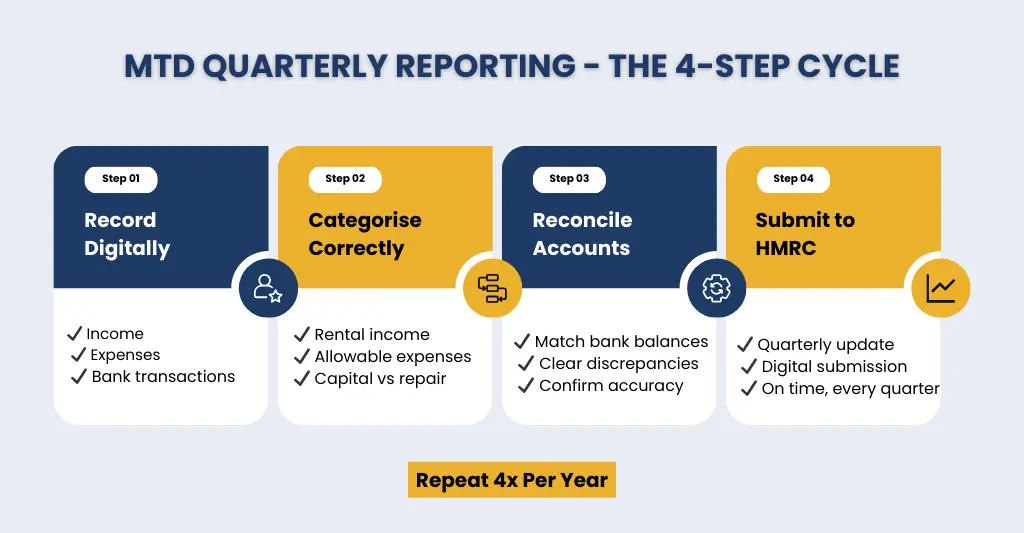
What Exactly Goes Into MTD Quarterly Updates?
Quarterly updates, as defined by Making Tax Digital for Income Tax, are structured summaries of your income and expenses provided digitally to HM Revenue & Customs. Remember, they are not a full tax return or final tax calculation; rather, they are quarterly updates that must be supported by accurate digital records and correctly categorised transactions.
For UK landlords and sole traders, the filing is rarely the most difficult part. It is the understanding of what should (and should not) be included in those data. Let’s understand it further.
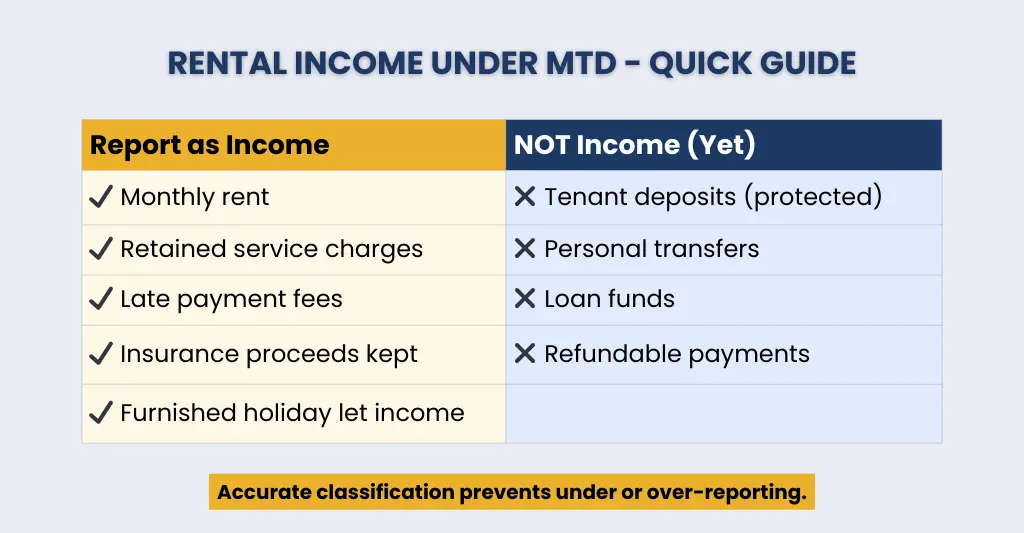
Income Categories – The 4 Landlord Traps
For landlords, income reporting appears straightforward: “Just report the rent.” However, this is where many mistakes originate. Here are four common areas in which landlords are caught:
- Including Deposits as Income: Tenant deposits placed in an approved protection scheme are not considered rental income. They only become revenue if you are legally permitted to keep them, such as to cover damages or overdue rent. Only then are they qualified as income.
- Forgetting Other Property Income: Rental income isn’t just monthly rent. It may also include:
- Service charges retained
- Late payment fees
- Insurance claim proceeds
- Income from furnished holiday lets
Missing these can mean under-reporting.
- Mixing Personal and Rental Income: If rent is paid into a personal bank account, transactions may become disorganised. Under MTD, clean digital records are required. Inconsistent differences between personal and property income make reconciliation difficult.
- Incorrect Timing of Income: MTD quarterly updates depend on your accounting method (cash or accrual basis). Recording income in the incorrect quarter might affect your reported results and create uncertainty later in the year.
Expense Categories – Where Sole Traders Trip Up
Sole traders frequently suffer more with expenses than income.
The problem is not a lack of expenses, but rather their incorrect classification.
Here are common trouble areas:
- Mixing Personal and Business Costs: Using the same card for everything makes it difficult to justify deductions. Only the business component of an expense can be claimed, and it must be carefully documented.
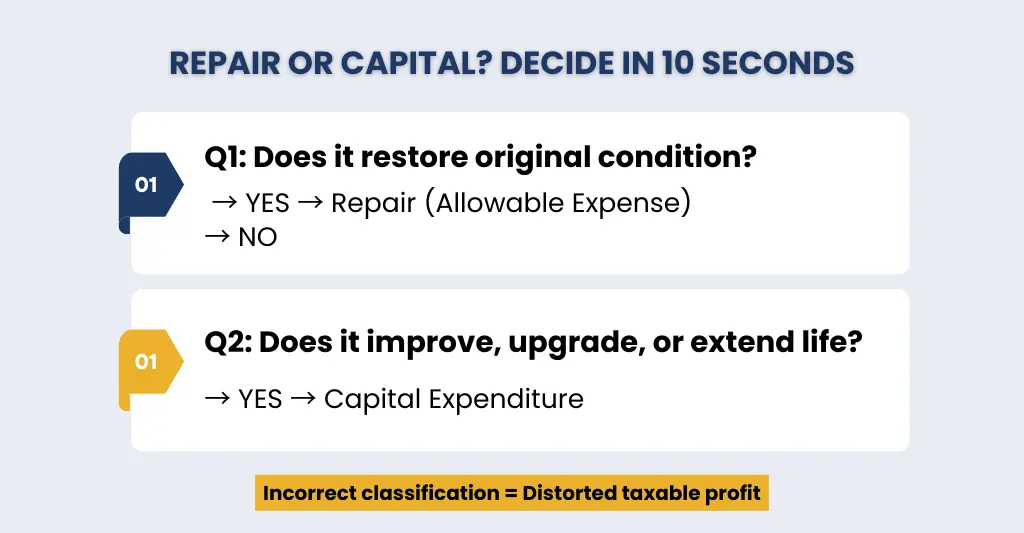
- Repairs vs Capital Expenditure: This is a big source of confusion.
- Repairs (bringing something back to its original state) are normally allowable expenses.
- Capital improvements (upgrades or added value) are considered differently.
- Getting this wrong has an impact on taxable profit.
- Home Office and Mixed-Use Expenses: Claiming for home office, phone bills, or transportation expenses necessitates appropriate calculating procedures. Overclaiming or inconsistency in calculations might cause compliance issues.
- Subscription and Software Costs: Many sole traders fail to properly categorise recurring tools such as accounting software, marketing platforms, cloud storage, and related services.
Why Quarterly Reporting Feels Chaotic – And Breaks Cash Flow (But is a Necessity)
The goal of introducing Making Tax Digital for Income Tax was straightforward: more frequent reporting, greater visibility, and fewer surprises.
However, for many UK landlords and sole traders, the reality is quite different. Quarterly reporting isn’t just about sending figures to HM Revenue & Customs more often. It also means you need clear, accurate, and up-to-date financial records throughout the year.
When bookkeeping isn’t consistent, chaos occurs.
- Last-Minute Bookkeeping Panic: Many landlords and sole traders continue to operate in “catch-up mode.” But till then, the transactions pile up, receipts are left in the drawers, and bank balances are not reconciled periodically.
Then the quarterly deadline approaches, and suddenly, you are:- Sorting through three months’ transactions
- Guessing expenditure categories.
- Trying to match bank balances.
- Rushing to escape penalties.
- This reactive approach transforms each quarter into a little year-end scramble.
- Inaccurate Profit Figures Create Cash Flow Confusion: When records are not routinely updated, the profit reported in your quarterly update may not be accurate.
This may happen due to the following reasons:- Overestimating your profits and assuming an increased tax liability.
- Underestimating your profits- resulting in an unpleasant surprise later.
- Ignoring permissible costs that lower your taxable income.
- You cannot prepare for tax payments with confidence unless you have accurate, real-time numbers.
- Uncertainty – it interrupts cash flow the most.
- Poor Categorisation Distorts Your Tax Position: If expenses are misclassified, or capital purchases are handled as routine repairs, your stated profit is affected.
This leads to the following:- Adjustments at year end
- Additional accountant inquiries
- Confused about how much tax to save aside. (To gain a clear understanding of legal ways to save on tax, read our guide on How to Pay Less Tax UK: 7 Strategies to Choose From )
- Quarterly reporting works best when bookkeeping is accurate from the start.
- No Clear Tax Provision Planning: One of the most common cash flow blunders is failing to set aside funds for taxes on a regular basis. When landlords and solitary traders don’t know their true profit situation every quarter, they frequently:
- spend more than they should.
- Unable to set aside money for taxes
- Feel pressured as payment deadlines approach.
- Administrative Overload: For small businesses, time is limited. Every hour spent reconciling accounts at the last minute is an hour not spent:
- Managing tenants
- Winning new clients
- Delivering services
- Growing revenue
When financial processes are disorganised, quarterly updates feel like interruptions rather than routine compliance steps.
But It’s a Necessity
Quarterly MTD is no longer optional, especially due to increasing compliance focus after recent Autumn Budget revisions. HMRC wants businesses and landlords to keep digital records and make regular updates under Making Tax Digital (MTD) for Income Tax.
Quarterly reporting ensures that your records are correct throughout the year, avoids last-minute errors, increases cash flow visibility, and lowers the chance of penalties.
For a practical, step-by-step approach, read our detailed guide: MTD for Income Tax: Operational Readiness Guide for UK Businesses (2026), where we explain how to prepare, what systems you need, and how to stay fully compliant.
Best Small Business Accounting Software for MTD – With MTD Accountants Oversight
Choosing the correct accounting software is important, but getting experienced advice makes all the difference when it comes to Making Tax Digital for Income Tax Compliance.
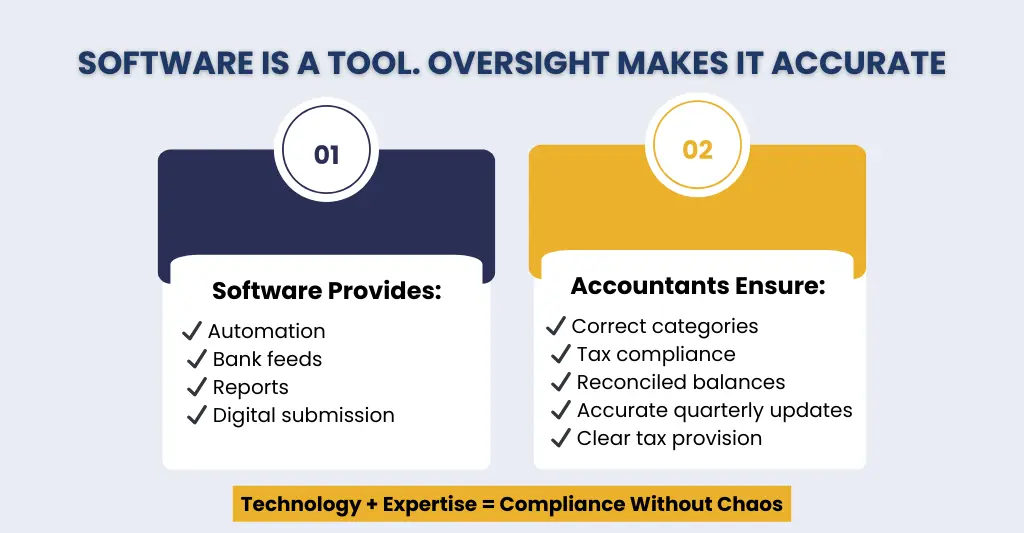
Software alone provides tools.
However, when those instruments are set up and supervised by accountants who understand MTD, chaotic quarterly reporting becomes a seamless, regulated procedure.
The following are some of the most popular small business accounting platforms that interact with MTD – with accountants’ oversight a must (bonus).
Xero – Simple, Cloud-Based and Partner-Friendly:
A favourite among sole traders and landlords alike, Xero offers:
- Automatic bank feeds
- Real-time dashboards
- Easy categorisation of income and expenses
- Seamless integration with MTD submissions
Why accountant oversight matters: Accountants with MTD experience can customise your chart of accounts, check spending categories, follow UK tax requirements, and monitor reconciliations to ensure quarterly returns are always accurate.
QuickBooks Online – Flexible and Widely Supported:
QuickBooks Online is ideal for businesses that want:
- Strong reporting capabilities
- Custom invoice templates
- Good mobile app
- Third-party integrations
With expert support: Accountants assist in optimising settings, verifying reconciliations, and ensuring digital records match MTD criteria, hence avoiding last-minute changes before submission.
FreeAgent – Designed for Freelancers & Sole Traders:
FreeAgent – Designed for Freelancers & Sole Traders: FreeAgent is easy to use and designed specifically for solo operators. The key features include:
- Simplified income/expense tracking
- Cash flow dashboards
- Automated reminders
- MTD submissions- income tax ready
Where accountants add value: They make sure transactions are properly categorised, reconciliations are complete, and quarterly updates accurately reflect your profit and tax picture.
Zoho Books – Cost-Effective and Customisable:
Zoho Books offers:
- Comprehensive invoicing
- Expense tracking
- Automated workflows
- MTD-ready features
With professional oversight: MTD accountants can customise categories, match books with industry requirements, and create reporting routines that save hours of administrative work each month.
Sage Business Cloud Accounting – Trusted & Established:
Sage is a classic choice for many small businesses and property owners, thanks to:
- Strong compliance support
- Scalable features
- Good UK tax integration
Accountant supervision ensures: Your software setup is compliant, reconciliations are timely, and submissions to HM Revenue & Customs are error-free.
E2E’s Outsourced Finance Department – Your Complete MTD Quarterly Solution
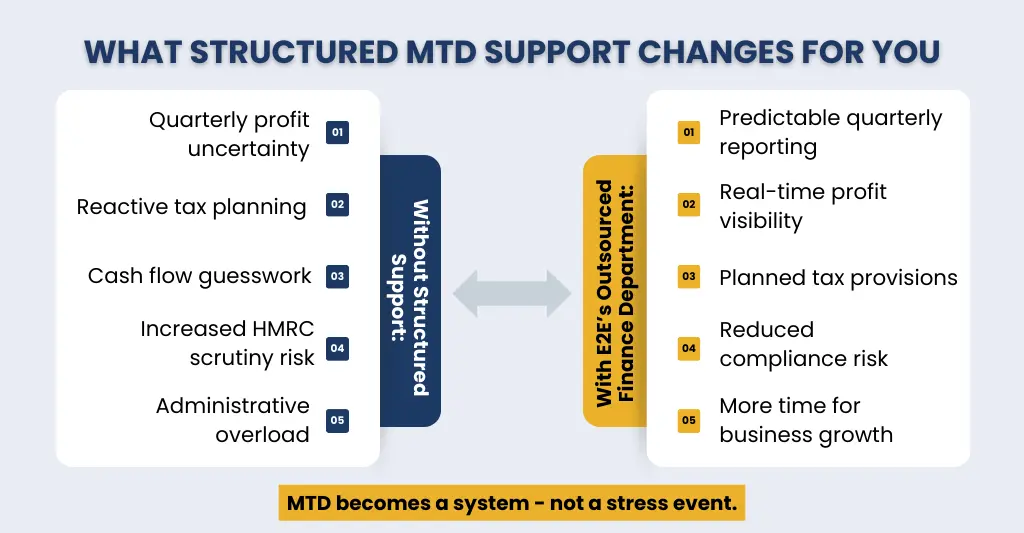
MTD quarterly reporting does not have to be overwhelming. E2E’s Outsourced Finance Department provides more than just submission support; you also get year-round bookkeeping, correct categorisation, reconciliations, cash flow monitoring, and proactive tax planning, all handled by qualified UK accounting professionals.
Instead of stressing about deadlines or HMRC penalties, you remain compliant, organised, and financially secure.
Allow E2E to handle your MTD journey so you can focus on expanding your business rather than meeting quarterly requirements. Contact us today to make MTD simple and stress-free.
People Also Ask:
When do I send my first MTD quarterly update in 2026?
If you follow the standard UK tax year (6 April to 5 April), your first MTD quarter will run from 6 April 2026 to 5 July 2026
The submission deadline will be: 7 August 2026
You must file it digitally using MTD-compatible software with HM Revenue & Customs under Making Tax Digital for Income Tax.
What if my tenant pays rent late across quarter boundaries?
If the tenant pays rent late, you report the income in the quarter in which the money is received, rather than when it was due. Most UK landlords who use MTD for income tax adhere to the cash basis. This means that income is recorded as it enters your bank account.
How do joint landlords handle MTD quarterly reporting?
Making Tax Digital for Income Tax requires each joint landlord to disclose their own share of rental income and expenses.
Income and expenses are divided according to ownership proportion, and each individual files their own quarterly update to HM Revenue & Customs.
Can I use estimates for MTD quarterly submissions?
No, under Making Tax Digital for Income Tax, quarterly updates must be based on real digital records rather than approximate estimations.
You need to use:
– Real income received (or due, according to your accounting technique)
– Properly recorded and classified expenses
Small changes can be made later, but frequent estimates rather than keeping accurate records might lead to problems with HM Revenue & Customs.
What happens if I miss my MTD quarterly deadline?
If you miss an MTD quarterly submission deadline, HMRC applies a points-based penalty system. Here’s how it works (in short):
– Each missed deadline = 1 penalty point
– Points build up over time
– Once you reach the penalty threshold (usually 4 points for quarterly filers), you receive a £200 fine
– Every further missed submission after that = another £200 penalty
Points expire after a period of good compliance, but only if you submit all required returns and meet deadlines going forward.
Do I need different software for property vs self-employment income?
No. You can use the same MTD-compatible software for both. Just make sure your income and spending are properly categorised before reporting to HM Revenue & Customs.
Can my accountant submit MTD quarterly updates for me?
Yes. Your accountant can submit quarterly updates on your behalf under Making Tax Digital for Income Tax, as long as they are approved by HM Revenue & Customs.
They will use MTD-compatible software to digitally file your income and expense summaries. This is frequently the most straightforward technique to ensure accuracy and avoid penalties.
