

In the high-stakes world of scaling a UK business, there is a dangerous misconception that often halts growth in its tracks. It is the belief that “Finance” is just a box you tick once a year when you send a carrier bag of receipts to an accountant. If you are a founder aiming for a £5m, £10m, or £50m turnover, you must realise that you don’t just need an accountant; you need a powerhouse.
You need an engine room that processes data, manages operations, guards your cash, and protects your capital. You need a fully managed finance function.
The question here isn’t whether you need one- your ambition has already made that a requirement. The real question is: should you build it brick-by-brick internally, or should you partner with a specialised provider?
The Hidden Costs of Building a Finance Function Internally
When most CEOs think about building an internal finance team, they look at the base salaries. They think, “I’ll hire a bookkeeper for £32k, a manager for £55k, and eventually an FD.” But the “sticker price” of a salary is just the tip of the iceberg. Below the surface lie the “hidden” costs that can bleed a growing business dry.
- Employer On-Costs: In the UK, you aren’t just paying a salary. You are paying Employer National Insurance (currently 15%), pension contributions (auto-enrollment), and potential bonuses. A £55,000 hire actually costs the company closer to £65,000 before they’ve even opened their laptop. To know more of the components of PAYE, read our detailed guide on it.
- The Recruitment Merry-Go-Round: The UK finance talent market is incredibly tight. Between recruitment agency fees (often 15–25% of the first-year salary) and the dozens of hours the CEO spends interviewing, the cost of simply finding the person is immense.
- Technology Stack & Licenses: Building a modern finance department requires a sophisticated suite of tools-ERP systems, OCR software for expenses, payroll modules, and forecasting tools. These subscriptions add thousands to your annual “hidden” overhead.
- Office & Infrastructure: Every internal hire requires a desk, a laptop, insurance, and physical space. In major UK cities, the real estate cost of a finance team is a significant fixed liability that limits your flexibility.
- Training & Development: UK tax laws change constantly (MTD, R&D credit shifts, VAT updates). You either pay for your staff’s training, or you pay for their mistakes.
The Challenges of Running an Internal Finance Function
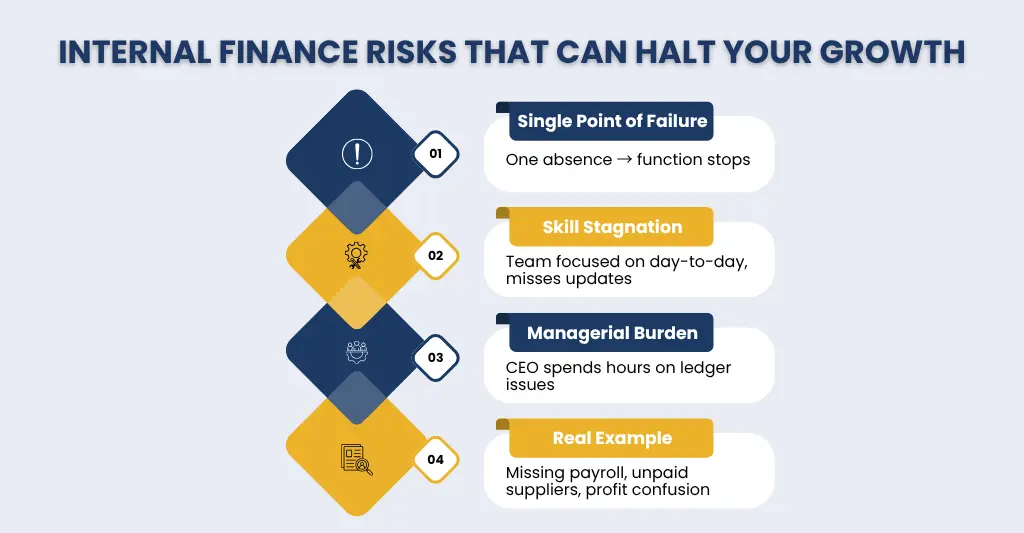
Even if you have the capital to build internally, you face the “Single Point of Failure” risk. This is the most common reason internal finance functions fail during a growth spurt.
Consider David, the CEO of a fast-growing logistics firm. He hired a brilliant internal Finance Manager. For two years, things were great. Then, the manager went on maternity leave, followed by a sudden resignation from the junior bookkeeper. Suddenly, the “system” (which lived mostly in the manager’s head) disappeared. David was left with unpaid suppliers, confused payroll, and no one to explain why the margins had dipped during a record sales month.
Common internal challenges include:
- Lack of Redundancy: If your internal person is sick or leaves, the entire function stops.
- Skill Stagnation: Internal staff often focus so much on the “day-to-day” that they fall behind on UK tax changes or new automation technologies that could save the business money.
- The Managerial Burden: A finance team needs managing. As a CEO, do you really want to spend your time reviewing a bookkeeper’s performance or helping them troubleshoot a ledger error? Every hour you spend managing finance is an hour you aren’t spending on sales or product development.
The Benefits of Outsourcing a Fully Managed Finance Function
This is where the paradigm shifts. At E2E Accounting, we are not “accountants” in the traditional, reactive sense. We provide a fully managed outsourced finance team that integrates directly with your team and business operations. We are not just a service provider; we are the financial department you thought you had to build yourself.
#1. Instant Access to a “Brain Trust”
When you outsource, you don’t just get one person; you get a tiered team. You get the speed of a transactional clerk, the precision of a management accountant, and the strategic foresight of a CFO. You get a collective of experts who see across multiple industries and bring that “best practice” knowledge to your board table.
#2. Operational Integration
A fully managed function doesn’t just look at the bank- it looks at the business. We manage your “Order to Cash” and “Procure to Pay” cycles. We ensure that your sales team is billing correctly and your suppliers are being managed strategically to maximise your working capital.
#3. De-Risking Your Growth
Outsourcing moves the risk from your shoulders to ours. We provide the continuity. If a team member is away, our systems and redundant staffing ensure your business doesn’t miss a beat. We handle the tech stack, the training, and the compliance updates. You get a “future-proofed” department that scales as you do.
What to Look for in an Outsourced Finance Partner
If you are looking for a fully managed finance function, you must look beyond the “tax return” firm. A true partner should offer:
- Strategic Alignment: Do they understand your 5-year exit plan? Are they preparing your books for the due diligence of a future sale or investment round?
- Real-Time Visibility: Do they offer live dashboards that show your cash position today, not 30 days ago?
- Operational Breadth: Can they handle payroll, credit control, and international VAT even on logistics, or do they only do “the books”?
- Technology Leadership: Are they pushing you toward automation (OCR, AI-driven reconciliation), or are they still asking you to email PDFs and spreadsheets?
The Cost of Outsourcing vs. Building Internally: Which Is More Cost-Effective?
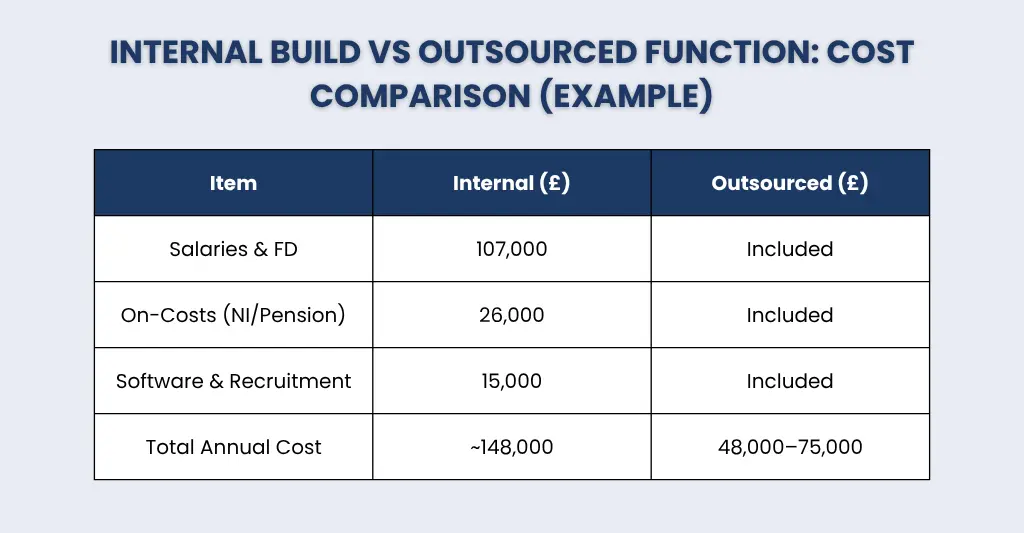
Let’s look at a comparative breakdown for a typical UK business with a £3.5m turnover.
Internal Build (Estimate)
- Bookkeeper (Full-time): £32,000
- Finance Manager (Full-time): £55,000
- Part-time FD (2 days/month): £20,000
- On-costs (NI/Pension/Insurance): £26,000
- Software & Recruitment Fees: £15,000
- Total Annual Cost: ~£148,000
Fully Managed Finance Function (Outsourced)
By partnering with a firm like E2E Accounting, the same business often spends between £48,000 and £75,000 per year.
The Financial Savings: Over £70,000 per year. More importantly, that £70k saving comes with higher quality output, better technology, and zero managerial headache for the CEO. The “cost-effectiveness” isn’t just in the cash saved; it’s in the “opportunity gain” of having a CEO who is focused on scaling the business rather than chasing an internal bookkeeper for a report.
How E2E Accounting’s Fully Managed Finance Function Can Help Your Business
E2E Accounting is the finance department that growing businesses cannot afford to ignore. We have intentionally deviated from the “traditional accountant” model because we know it doesn’t work for modern scale-ups. We are not a bookkeeping firm; we are a fully managed finance and operations function.
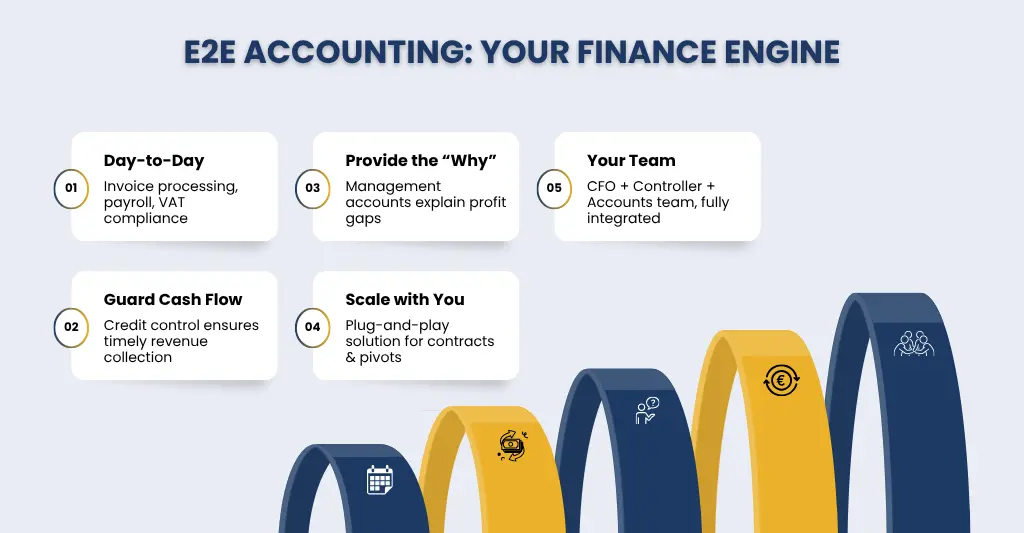
How we act as your operational engine:
- We manage the Day-to-Day: From processing thousands of invoices to managing complex payroll across different UK regions – we do it all.
- We Guard Your Cash Flow: Our credit control teams are relentless but professional, ensuring your hard-earned revenue actually hits your bank account.
- We provide the “Why”: Through deep-dive management accounts, we explain why your profit isn’t matching your sales growth and how to fix it.
- We Scale with You: We are a “plug-and-play” solution. When you land a major contract, we ramp up. When you pivot, we provide the data to support the move.
We are your CFO, your controller, and your accounts team, all wrapped into one seamless, technology-driven partnership. We ensure that your finance function is an asset, not a bottleneck.
Conclusion: Choosing the Right Finance Function for Your Business
Building internally is an exercise in managing people and overhead. Outsourcing a fully managed finance function is an exercise in managing growth and strategy. If you want to spend your time managing a back-office team, dealing with recruitment, and worrying about sick days, build internally. But if you want to spend your time leading your market and scaling your vision, the choice is clear. You need a partner who is as ambitious as you are.
Stop Being Your Own Finance Manager
Your time is your most valuable asset. Every hour you spend looking at a spreadsheet or chasing a missing receipt is an hour you aren’t spending with a client or innovating your product.
E2E Accounting is the bridge between where your business is and where you want it to be. Contact E2E Accounting today and let us show you what a truly managed finance and operations function looks like.
People Also Ask:
What is a fully managed finance function?
It is a comprehensive service where an external firm takes over the entire financial and operational running of your finance department. This includes everything from bookkeeping and payroll to strategic CFO advice, tax planning, and operational support like credit control.
How much does it cost to build a finance function internally?
For a scaling UK business, a basic 3-person internal team typically costs between £130,000 and £160,000 per year, including National Insurance, benefits, software, and recruitment costs.
Why is outsourcing more cost-effective than building internally?
Because you gain “fractional” access to high-level experts. You don’t need a full-time FD, but you do need their brain. Outsourcing allows you to pay for the expertise you need without the “dead time” and high overhead of full-time staff.
What should I expect from an outsourced finance partner?
Expect proactivity. You should receive real-time data, strategic insights, automated processes, and the peace of mind that all UK compliance (VAT, PAYE, Corporation Tax) is being handled by experts.
How can E2E Accounting help my business scale its finance function?
We remove the “administrative ceiling.” We implement the systems and provide the manpower that allows your financial operations to handle 10x your current volume without you having to hire a single person.
Is E2E Accounting’s fully managed finance function customisable?
Absolutely. We don’t believe in “cookie-cutter” accounting. We tailor our reporting, our operational support, and our strategic advice to the specific goals and challenges of your industry.
What are the risks of not having a fully managed finance function?
The risks include “profitable bankruptcy” (high sales but no cash), HMRC penalties, fraud, and a lack of data that leads to poor strategic decisions. Without a robust function, you are essentially flying your business through a storm without radar.
