

Think you are a company owner who is in a hurry to complete month-end reports. Your accounting software has AI-powered features to automatically classify transactions, provide projections, and even create financial summaries. Previously, it used to take days; now it just takes hours. Everything appears to be controlled, exact, and efficient.
No doubt that AI and other softwares are making our work easier and quicker. Still, one question arises: what if AI commits a mistake, what happens if sensitive data is processed by automated systems in a way that violates ethical norms or introduces prejudice into financial decisions? And how can companies make sure that a growing reliance on technology doesn’t threaten professional judgment, transparency, or compliance?
In this blog, we will be discussing the main modifications made to the 2026 ICAEW Code of Ethics, their implications for companies that use automation and artificial intelligence, and the allowable actions you can take to be compliant while taking advantage of new technology.
What the 2026 ICAEW Code of Ethics Actually Changes
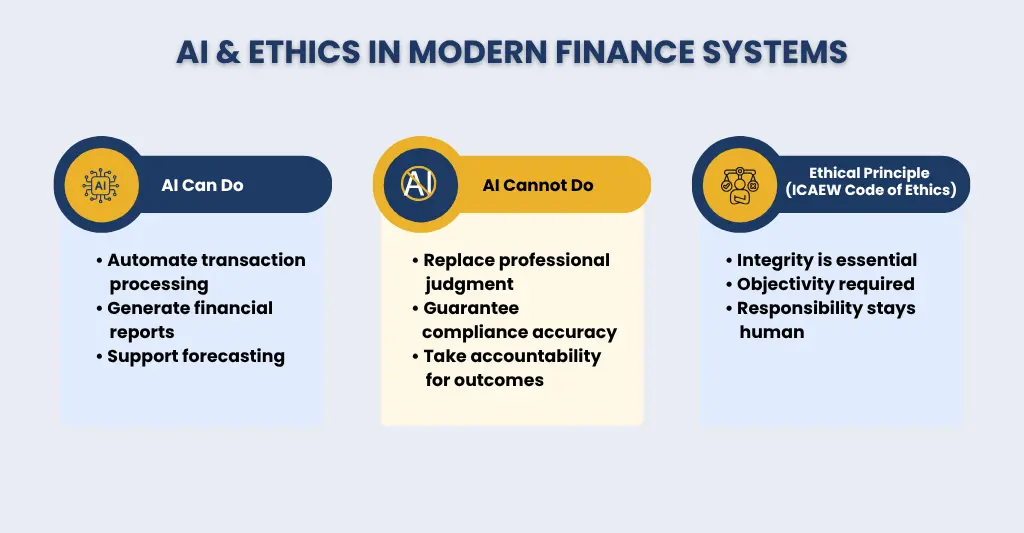
The fundamental values of integrity, objectivity, professional competence, confidentiality, and professional behaviour are not replaced by the 2026 ICAEW Code of Ethics. Rather, it modernises the application of these ideas in a setting that is becoming more and more influenced by automation, artificial intelligence, and digital technology.
Key changes include:
- Increased accountability for automated financial procedures and outcomes produced by AI.
- Increased emphasis on expert judgment, making sure technology complements human monitoring rather than replaces it.
- Greater standards for confidentiality and data control when utilising AI-powered products.
- More focus on transparency, necessitating that professionals and corporations comprehend how automated selections are made.
- Updated ethical guidelines for new technologies that assist organisations in striking a balance between professional standards and innovation.
Where Businesses Face the Biggest Automation and Compliance Risks
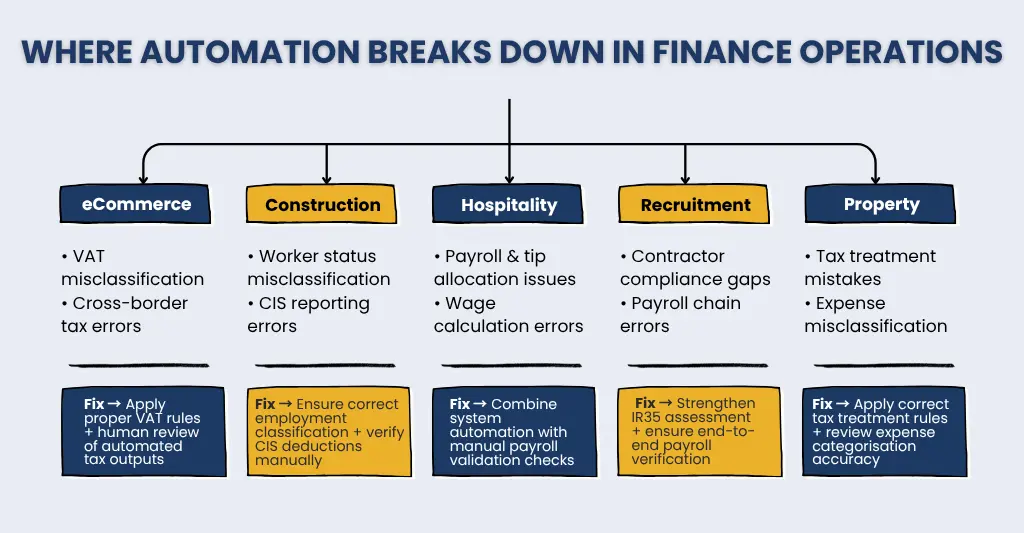
eCommerce: The Risks of Unchecked Marketplace Syncing
Sales, refunds, fees, and inventory information can be automatically synchronised with your accounting software through marketplace connectors. This is especially risky for OSS and IOSS VAT rules for ecommerce sellers, where automated systems often miss cross-border VAT nuances entirely.
New Reality:
Businesses remain responsible for financial accuracy, even when transactions are processed automatically.
Key Threats:
- VAT on marketplace sales is not applied correctly.
- Transactions that are missing or duplicate because of sync issues.
- Income, fees, or refunds that were incorrectly classified.
- Financial reports that are inaccurate due to incomplete data.
- Less insight into the decision-making process of automated systems.
eCommerce accountants provide the crucial monitoring required to identify VAT problems, reconcile marketplace transactions, and keep proper financial records even with automated synchronisation.
Construction (CIS): Worker Status Cannot Be a Software Automation
Payroll and CIS software are now widely used by construction companies to automate tax deductions and worker classifications. Although these tools increase productivity, they are not entirely accurate in determining job status.
New Reality:
Regardless of what the software recommends, companies are still accountable for making sure employees are appropriately classified under the 2026 ICAEW Code of Ethics.
Key Threats:
- Incorrect categorisation of employees as employed or self-employed
- Mistakes in CIS and VAT reporting and deductions.
- Penalties from HMRC for automatic misclassifications.
- Over-dependence on software without checking specific agreements and contracts.
While technology can help with CIS compliance, human judgment and appropriate evaluation are still necessary when making choices about employment status.
Hospitality: Fluid Payroll and Tip Allocation (Tronc) Triggers
Automated payroll systems are crucial to the management of shifting employee hours, overtime, tips, and tronc arrangements in the hospitality industry. Automation reduces administrative costs, but it also introduces new compliance issues.
New Reality:
Companies are still in charge of making sure payroll systems accurately and fairly process wages, deductions, and tip distributions.
Key Threats:
- Wages, overtime, and holiday compensation are calculated incorrectly.
- Mistakes in the distribution and documentation of tronc and hospitality VAT compliance.
- Payroll software that uses inaccurate or out-of-date employee data.
- Insufficient control over payroll decisions made automatically.
Payroll management can be made easier by automation, but human review and routine checks are necessary to maintain ethical standards and compliance. Hospitality accountants assist companies in managing varying workforce costs, ensuring compliance with HMRC regulations, and verifying payroll accuracy.
Recruitment: Supply Chain Exposure in Mass Contractor Lines
Automated systems are frequently used by recruitment firms to handle payroll, timesheets, contractor records, and compliance checks. Although these technologies increase speed, they also create problems when working with a big number of temporary workers.
New Reality:
The need to confirm contractor status, payments, and compliance along the supply chain is not eliminated by automation.
Key Threats:
- Worker classification and right-to-work checks are incorrect.
- Inaccurate contractor data results in payroll and holiday pay calculation errors.
- Failures in compliance went through several levels of the supply chain.
- Overuse of automated technologies for verification and onboarding.
Although technology can make hiring processes more efficient, human monitoring is still necessary to ensure accuracy, ethics, and compliance. Recruitment accountants assist organisations in managing contractor payroll, keeping accurate financial records, and guaranteeing adherence to employment and tax laws.
Running payroll, timesheets, and contractor records on autopilot? See what proper recruitment accounting software should actually check before it submits anything.
Property: The Crackdown on App-Generated Loopholes
Rent collecting, expense tracking, property management, and financial reporting are all increasingly dependent on automated platforms used by real estate companies. However, automation can create problems if systems make assumptions without enough evaluation.
New Reality:
Property administration can be made easier by technology, but companies are still in charge of making sure that transactions, tax treatment, and reporting are correct.
Key Threats:
- Income and costs related to property are incorrectly classified.
- Automated computations that result in reporting or tax errors.
- Missing paperwork related to online purchases.
- Excessive dependence on software without expert evaluation.
Automation can increase productivity, but in order to maintain compliance and prevent expensive errors, human oversight and routine checks are crucial. Compare specialist property accountants who combine automation with expert oversight.
Why Human Oversight Still Matters in Automated Finance Systems
Automation and AI can speed up financial procedures, but they cannot take the place of expert judgment. Even when software handles most of the work, businesses are still accountable for the accuracy, compliance, and moral use of their financial data.
Why human oversight is essential:
- Confirms outcomes produced by AI before submitting or reporting them.
- Finds mistakes and irregularities that automated methods would miss.
- Guarantees adherence to the 2026 ICAEW Code of Ethics and HMRC requirements.
- Applies expert judgment to difficult tax and financial issues.
- Safeguards private financial information and makes sure AI tools are used responsibly.
- Ensures accountability because companies are still responsible for judgments made by automation.
A straightforward idea is reaffirmed in the 2026 ICAEW Code of Ethics: AI should assist financial professionals, not take their place.
The 2026 Checklist: What to Expect From Your Accounting Partner
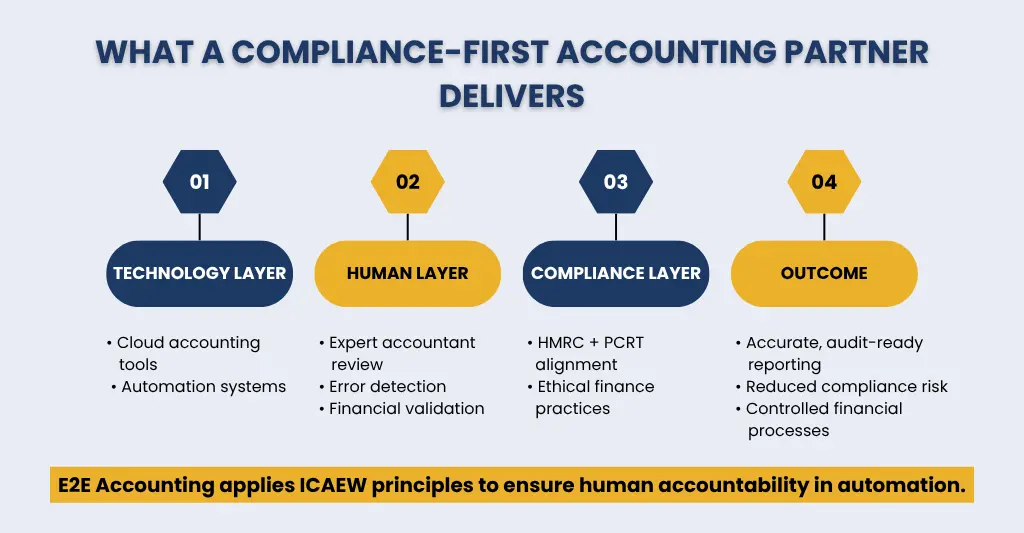
As automation and artificial intelligence grow commonplace in the financial industry, your accounting partner should provide more than simply technology. They should ensure that your company remains safe, compliant, and in line with the 2026 ICAEW Code of Ethics by combining digital tools with professional supervision.
Human-Verified Financial Reviews:
Before any information is submitted or used for decision-making, your accounting partner should examine AI-generated reports, reconciliations, and financial data to find mistakes, confirm accuracy, and guarantee compliance.
PCRT-Aligned Risk Oversight:
Early detection of tax and compliance concerns by your accounting partner can help to ensure that financial decisions are in line with current UK rules and the standards of Professional Conduct in Relation to Taxation (PCRT).
Multi-System Reconciliation Processes:
To guarantee consistency, identify mistakes early, and keep correct financial records, your accounting partner should routinely reconcile data across several systems, such as accounting software, payroll, banking, and CRM platforms.
Clear Audit Trails and Compliance Checks:
To guarantee that every transaction is correct, traceable, and complies with HMRC and legal standards, your accounting partner should keep transparent audit trails and do routine compliance checks.
Still you may have a question why an accounting partner is required even when you have hi-tech softwares and tools. You can read more information in our blog How an Outsourced Finance Team Can Solve the Challenges of Scaling Your UK Business.
How E2E Accounting Supports Compliance-First Finance Operations
At E2E Accounting, we provide compliance-first financial solutions by combining cutting-edge cloud technology with industry-specific knowledge. In contrast to businesses that only use automation, we take a Zero Automation Bias strategy, meaning that every AI-generated report, transaction, and financial procedure is examined by qualified accountants to guarantee accuracy and remove errors caused by technology. While our procedures are in line with HMRC regulations and PCRT principles, our staff are aware of the particular compliance issues that arise in a variety of industries, such as eCommerce, construction, hotel, recruitment, and real estate. Accurate financial reporting, improved compliance, and the assurance that your company is still audit-ready in an increasingly computerised world are the outcomes.
Conclusion: Safeguarding Your Business Longevity
Finance is changing due to AI and automation, yet accountability and compliance are still human duties. Technology should complement professional judgment, not take its place, according to the 2026 ICAEW Code of Ethics.
Businesses can lower risk, preserve compliance, and build long-term trust by combining intelligent automation with professional oversight, robust internal controls, and moral financial practices. Working with expert accountants guarantees that your company is ready for both the current regulatory requirements and the financial landscape of the future. Talk to an accountant who will take responsibility — before your next filing, not after HMRC asks questions.
People Also Ask:
What is the 2026 ICAEW Code of Ethics update?
The proper application of AI, automation, and future technology is addressed in the 2026 ICAEW Code of Ethics, which updates ethical guidelines for accountants. In financial decision-making, it emphasises the necessity of human monitoring, expert judgment, transparency, and compliance.
What is automation bias in accounting?
Automation bias is the tendency to rely on Artificial Intelligence or accounting software without checking its results. If a skilled professional does not evaluate automated judgments, this could result in errors in tax calculations, financial reporting, and compliance.
How do the new ICAEW rules affect ecommerce businesses?
According to the revised ICAEW Code of Ethics, eCommerce companies must continue to supervise automated accounting procedures. Even with AI and automation, businesses are still in charge of making sure that marketplace data, VAT computations for eCommerce, and financial reporting are correct and compliant.
Can recruitment agencies still use automated platforms to manage thousands of weekly contractor lines?
Sure. Automated platforms can be used by recruitment firms, but human monitoring is still required. Even when operations are automated, they are still in charge of confirming labour classifications, contractor data, payroll accuracy, and compliance.
How does outsourcing to E2E Accounting insulate my property business from aggressive tax penalties?
E2E Accounting helps reduce tax and compliance risks by maintaining accurate financial records, reviewing automated transactions, ensuring correct tax treatment, and keeping your business aligned with HMRC and PCRT requirements. With expert oversight, potential issues are identified early, helping you avoid costly errors and penalties.
How can outsourced finance teams improve compliance?
Outsourced finance teams improve compliance by maintaining accurate financial records, monitoring regulatory changes, reviewing automated processes, and ensuring your business meets HMRC and PCRT requirements through expert oversight and regular compliance checks.
How do the ICAEW and PCRT updates affect SMEs?
SMEs must improve compliance, keep manual attention on AI and automated processes, and make sure financial records, tax reporting, and ethical procedures adhere to current UK regulatory standards in order to comply with the ICAEW and PCRT upgrades.
